GEO · AI Search · Citations
Search stopped sending links. Now it writes the answer and you need to be in it
Generative engine optimization gets your brand named, quoted and linked inside the answers ChatGPT, Perplexity, Gemini and Google AI Overviews write for your buyers. Different mechanics to SEO, same discipline underneath, and we report on citations rather than vanity impressions.
Get Your Free GEO AuditSee GEO Case Studies
The Honest Overview
What GEO actually is.
A definition first, because GEO is not SEO with a new label, and it is not a trick.
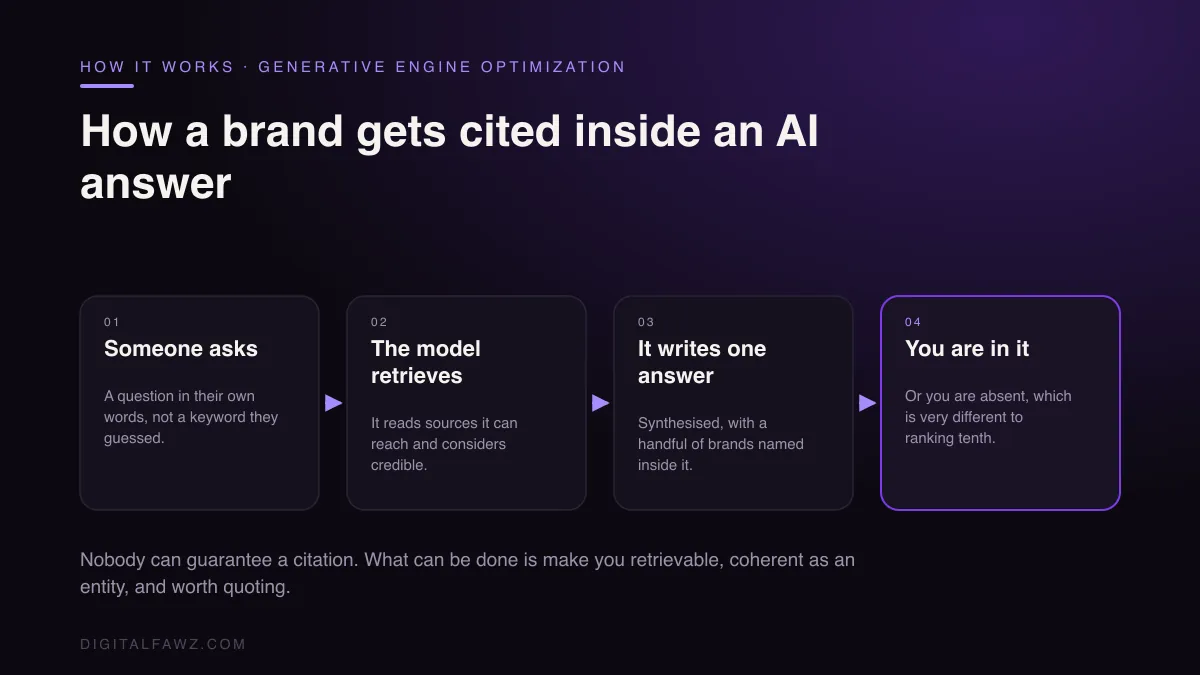
Traditional search hands the user ten links and lets them choose. A generative engine reads the web, decides what is true, and writes one answer. The user often never sees a list of links at all. If your business is not part of what the model considers credible on your topic, you are not ranked tenth. You are simply absent from the conversation.
That is the shift GEO addresses. The work is not about pleasing a ranking algorithm that sorts pages. It is about becoming an entity the model recognizes, associates with the right topics, and trusts enough to name. Models assemble answers from what they were trained on plus what they can retrieve live, which means both your long term footprint and your current, crawlable pages matter.
The demand for this is not theoretical. Search interest in generative engine optimization has climbed roughly twenty three fold in a year as businesses noticed traffic patterns changing underneath them. Agencies that treated it as a rebranding exercise for their existing SEO deck got found out quickly, because the levers genuinely are different.
Here is the part worth being blunt about. Nobody can guarantee a citation in an AI answer, and any agency promising you a fixed position in ChatGPT is selling something that does not exist. What can be done is measurable: make your content retrievable, make your entity coherent, earn the third party mentions models lean on, and then track whether your citation share actually moves.
Our GEO work runs on the same team and the same methodology as our search practice, because most of the underlying craft transfers. Entity clarity, structured data, clean information architecture, genuinely useful content and earned mentions have always been how you build authority. Generative engines simply raised the price of faking any of it, since a model that cannot parse your claims will not repeat them.
What is new is the measurement layer. Instead of rank tracking, we run prompt sets across the major assistants on a schedule, record whether you are cited, which competitors are cited beside you, and what the model says about you when asked directly. That last one surprises most clients on the first report, because models often carry an outdated or plainly wrong description of a business, and correcting it is frequently the highest value fix in the whole engagement.
Browse the search portfolio to see the numbers behind these claims.
Deliverables
What every engagement includes.
Eight workstreams that decide whether a model can find you, parse you, trust you and quote you.
AI Visibility Baseline
A fixed prompt set run across ChatGPT, Perplexity, Gemini and AI Overviews, recording where you are cited today and which competitors hold the answer instead.
AI Crawler Access Audit
Whether GPTBot, PerplexityBot, ClaudeBot and Google Extended can actually reach your content, and whether robots rules, rendering or paywalls are quietly blocking them.
Entity & Knowledge Graph
Consistent naming, sameAs links, founder and organization entities, and third party profiles so the model resolves you to one coherent business rather than three fuzzy ones.
Citation Earning Content
Original data, clear definitions, comparison tables and direct answers to the questions buyers actually ask assistants, written to be quoted rather than skimmed.
Structured Data Depth
Organization, Product, FAQ, HowTo and Article schema implemented properly, because structured data is the cheapest way to state a fact a model can lift verbatim.
Off Site Mentions
Placement in the listicles, roundups, directories and industry sources that assistants disproportionately retrieve from when asked to recommend a provider.
Answer Gap Analysis
Questions in your category where the model currently answers with a competitor, or with nothing useful, mapped to the content that would close each gap.
Citation Share Reporting
Monthly movement in how often you appear, against named competitors, with the exact prompts and the exact answers so nothing rests on our word.
Infographic · Our Method
The FAWZ GEO Sprint.
Five steps, repeated quarterly. This is the generative search implementation of our published FAWZ Growth Loop.
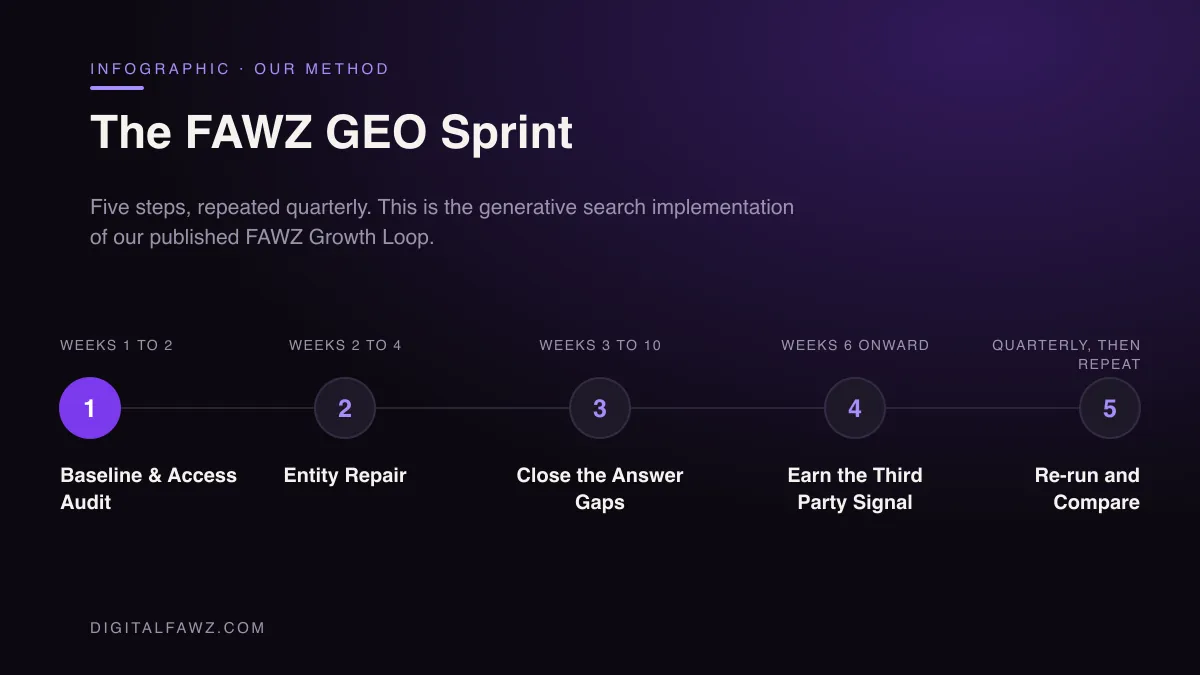
Baseline & Access Audit
We build the prompt set that matches how your buyers actually ask, run it across every major assistant, and record the answers verbatim. In parallel we check whether AI crawlers can reach your site at all. Blocked bots and JavaScript dependent content are the two most common reasons a well ranked site is invisible to models, and both are usually fixable in days.
Entity Repair
We make your business resolve to one thing. Consistent naming across the site and every third party profile, organization and person schema, sameAs links to the profiles models already trust, and correction of whatever wrong description the models are currently repeating about you. This step alone often changes what an assistant says when asked who you are.
Close the Answer Gaps
Every question where a competitor owns the answer becomes a content brief. The writing is deliberately quotable: a direct answer in the opening lines, defensible specifics, tables where a comparison is being asked for, and schema that restates the facts in machine readable form. Human written throughout, because models are increasingly good at recognising filler.
Earn the Third Party Signal
Models lean heavily on sources they did not have to trust you about. We pursue the roundups, directories, industry publications and comparison pages that keep appearing as citations in your category, and we tell you which ones refused, because a placement report with no failures in it is not a real one.
Re-run and Compare
The same prompt set runs again against the same assistants. You see the exact before and after answers, the change in citation share, and where competitors gained. Models update constantly, so this is a maintenance discipline rather than a project with an end date, and we say so before you sign rather than after.
Transparent Pricing
Plans.
Priced by the size of the prompt surface we monitor and the volume of content we produce. Every plan starts with the same baseline, because you cannot improve a citation share you have never measured.
Visibility Audit
$1,800
per month · for brands establishing a baseline
- AI visibility baseline across four assistants
- Crawler access audit and fixes
- Entity and schema repair
- 2 citation earning pages monthly
- Monthly citation share report
Growth · Most Popular
$3,600
per month · for brands competing for the answer
- Everything in Visibility Audit
- Expanded prompt set with competitor tracking
- 4 to 6 citation earning pages monthly
- Off site mention campaign
- Answer gap roadmap
- Dedicated GEO strategist
Category Authority
$7,000+
per month · for brands defending a category
- Everything in Growth
- Original research and data assets
- Multi market and multi language prompt sets
- Digital PR for citation sources
- Joint work with your SEO and PR teams
- Weekly strategy calls
Side by Side
Us versus a typical agency.
Seven questions that separate real GEO work from an SEO deck with the title changed. Use them on every vendor call.
| Question | Typical Agency | Digital Fawz |
|---|---|---|
| What is actually measured? | Traffic, as before | Citation share across a fixed prompt set |
| Can you guarantee a citation? | Yes, confidently | No, and anyone who says yes is lying |
| Crawler access checked? | Rarely looked at | GPTBot, PerplexityBot, ClaudeBot, Google Extended |
| What if the model describes you wrongly? | Not their scope | Entity repair, usually the first fix we make |
| Content approach? | Volume, AI written | Human written, quotable, schema backed |
| Reporting proof? | A summary slide | Verbatim prompts and verbatim answers |
| Is it a project or a practice? | Sold as a project | Told upfront it is ongoing maintenance |
Generative Engine Optimization Near You
Service areas.
Local market pages with city specific data, unique photography and localized case studies, never templated doorway pages.
Check It Yourself
Where this comes from.
Standards bodies, platform documentation and regulators, so nothing on this page rests on our word alone.
Schema.org vocabulary
The structured vocabulary that lets a machine state a fact about you unambiguously.
Straight Answers
GEO questions.
The questions buyers ask us on every discovery call, answered before the call.
What is generative engine optimization?
Generative engine optimization is the practice of making your brand legible and credible to large language models so you get named, quoted and linked inside the answers assistants like ChatGPT, Perplexity, Gemini and Google AI Overviews write for your buyers. Traditional search returns a list of links for the user to choose from; a generative engine writes one answer, so being absent from that answer is very different from ranking tenth.
How is GEO different from SEO?
The underlying craft overlaps heavily: entity clarity, structured data, clean architecture, genuinely useful content and earned mentions matter in both. What differs is the target and the measurement. SEO optimizes for a ranked position on a results page; GEO optimizes for inclusion inside a written answer, and is measured by citation share across a set of prompts rather than by keyword rankings. We run both from the same team because separating them produces contradictory work.
Can you guarantee my brand will appear in ChatGPT answers?
No, and we would be lying if we said otherwise. Model outputs vary between sessions, change with every model update, and are not a ranked index anyone can buy a position in. What we can do is measurable and honest: make your content retrievable by AI crawlers, make your entity coherent, earn the third party citations models lean on, and then show you whether your citation share moved, using the exact prompts and the exact answers.
How do you measure whether GEO is working?
We build a fixed prompt set that matches how your buyers actually ask about your category, then run it across the major assistants on a schedule. Each run records whether you were cited, which competitors were cited instead, and what the model says about you when asked directly. Reporting shows the verbatim answers before and after, so the change is visible rather than asserted.
How much do GEO services cost?
Our plans start at 1,800 US dollars per month for a baseline and repair programme, 3,600 dollars for competitive growth work with a wider prompt set and monthly content, and 7,000 dollars and above for category defence including original research and digital PR. That range sits in line with what credible providers charge for this work; anything dramatically cheaper is usually an SEO retainer with a new cover page.
How long before GEO produces results?
Access and entity fixes can change what a model says about you within weeks, because they alter what is retrievable right now. Citation share in competitive categories moves more slowly, usually across quarters, because it depends on earned third party sources and on model update cycles you do not control. We report monthly regardless, including the months where nothing moved.
Do I still need SEO if I invest in GEO?
Yes. Classical search still sends the majority of qualified traffic for most businesses, and generative engines retrieve heavily from pages that already rank well, so strong SEO is one of the inputs to GEO rather than a competing spend. The two are best bought together, which is why we run them off one strategy and one report rather than selling them as separate programmes.
What if the AI is saying something wrong about my business?
That is one of the most common findings in a first baseline, and one of the most valuable to fix. Models often carry outdated descriptions, wrong service lists, wrong locations or details from a previous version of a business. The repair is entity work: consistent facts across your own site, correct schema, and updated third party profiles the models retrieve from, followed by re-testing until the description changes.
Stronger Together
Related services.
GEO compounds fastest when it runs beside these three.
SEO Services
Generative engines retrieve heavily from pages that already rank. Strong classical search is an input to GEO, not a competing budget line.
Content Writing
Citations are earned by content built to be quoted: direct answers, defensible specifics and comparisons a model can lift cleanly.
ChatGPT Ads
GEO earns the citation; ChatGPT Ads buys the placement. Together they cover both halves of the same surface.
Ask ChatGPT about your category. See who it names.
Free AI visibility audit that runs your category prompts across four assistants and shows you the verbatim answers, including who is being cited instead of you.
Get Your Free AI Visibility Audit