Positioning · Messaging · Architecture
Strategy that makes every marketing dollar hit harder
Positioning, messaging architecture and competitive stance, decided with research and written down so clearly that your designers, writers, sales team and ad agency all pull in the same direction without a meeting.
Get Your Free Strategy AuditSee Strategy Case Studies
The Honest Overview
What brand strategy actually is.
A definition first, because 'strategy' is the most abused word in marketing.
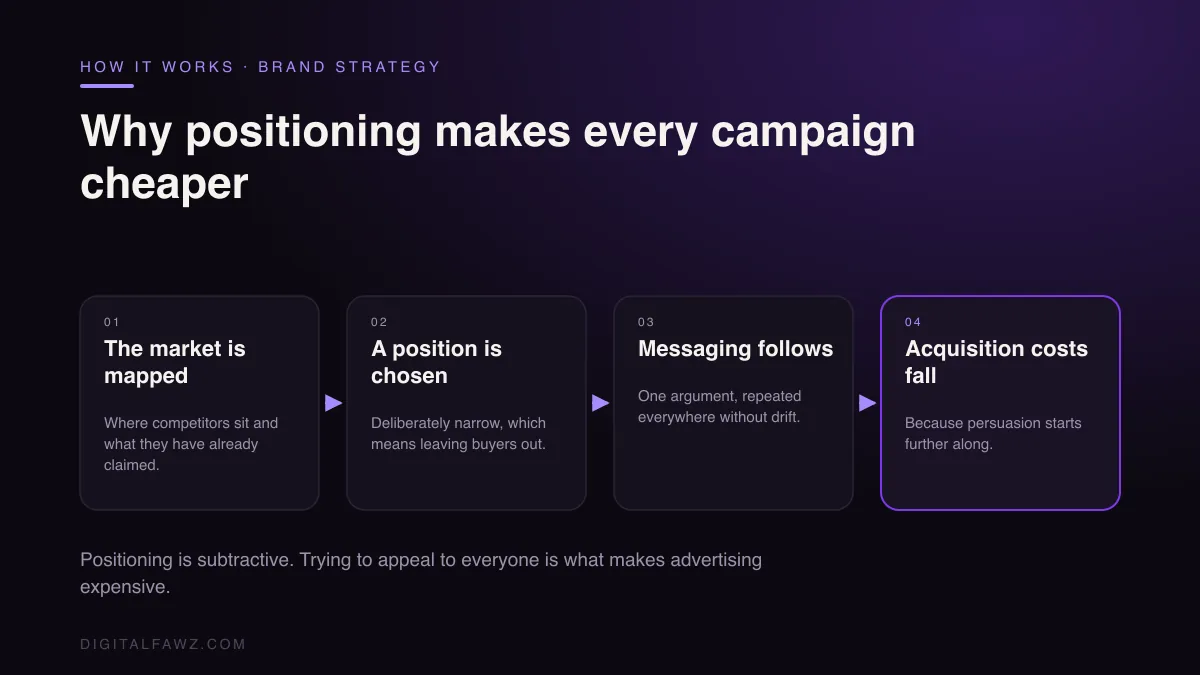
Here is how you know a company has no brand strategy. Ask three people who work there what makes the business different, and count the answers. If you get three different answers, or worse, three versions of 'quality and customer service', every marketing dollar that company spends is buying confusion. The ads say one thing, the website says another, the sales team improvises a third, and the buyer, who was only half paying attention anyway, remembers nothing.
This is not a small leak. Positioning failures are why good products lose to average ones constantly. The average buyer sees thousands of commercial messages a day and remembers almost none of them. The brands that survive that filter are not the loudest, they are the most consistent: one sharp claim, repeated everywhere, until the market files them under a single word. Volvo filed under safety. Slack filed under less email. What are you filed under? If the answer is nothing, that is the problem strategy exists to fix.
The mechanics matter more than the philosophy, so here is what the work actually produces. A positioning statement that passes the only test that counts: your competitor could not credibly say it. An audience definition sharp enough to also say who you are not for, because a brand for everyone is a brand for no one. A messaging hierarchy that ranks what you say first, second and third, so your homepage does not try to say nine things and land zero. And a competitive stance, the enemy your brand pushes against, because contrast is how humans understand anything.
Every one of those decisions is cheap to make on paper and brutally expensive to make by accident through two years of scattered campaigns. That is the entire economic argument for strategy: it moves the expensive mistakes forward in time to when they cost a workshop instead of a fiscal year.
Our strategy team has run more than 40 positioning engagements across SaaS, ecommerce, professional services and consumer brands, and the pattern is remarkably consistent: the strategy the founders expect walking in is rarely the one the research supports walking out. Customer interviews find the real reason people buy, which is often two levels more specific than the company's own pitch. Win loss analysis finds the real competitor, which is frequently 'doing nothing' rather than the rival everyone obsesses over. The deliverable is not our opinion. It is your customers' evidence, organized into decisions.
And because strategy that sits in a drawer is worth exactly nothing, every engagement ends with activation: message maps for your sales team, before and after copy for your key pages, briefing documents for your designers and ad partners. We measure our success by a simple test six months later: can your newest hire explain your positioning in one sentence? When the answer is yes, the strategy is working.
Browse the branding portfolio to see the numbers behind these claims.
Deliverables
What every engagement includes.
Eight deliverables that turn research into decisions and decisions into instructions your whole team can execute.
Market & Customer Research
Customer interviews, win loss analysis and survey data that reveal why people actually buy from you, in their own words.
Positioning Statement
The one sentence claim your competitors could not credibly make, pressure tested against every alternative your buyers consider.
Audience Definition
Segments defined by situation and struggle, not just demographics, including the explicit statement of who you are not for.
Messaging Architecture
A ranked hierarchy of claims, proof points and stories, so every page and pitch leads with what moves buyers most.
Voice & Tone Framework
How the brand speaks and how it never speaks, with rewritten examples from your own materials so the rules are unmistakable.
Brand Architecture
How products, sub brands and services relate and get named, before the portfolio becomes a junk drawer of logos.
Competitive Stance
A mapped landscape showing where rivals cluster and the open position your brand can own, plus the enemy narrative that creates contrast.
Activation Kit
Message maps for sales, rewritten key page copy, campaign platforms and creative briefs, so the strategy ships instead of shelving.
Infographic · Our Method
The FAWZ Strategy Sprint.
Five phases over six to eight weeks. This is the strategic implementation of our published FAWZ Growth Loop.
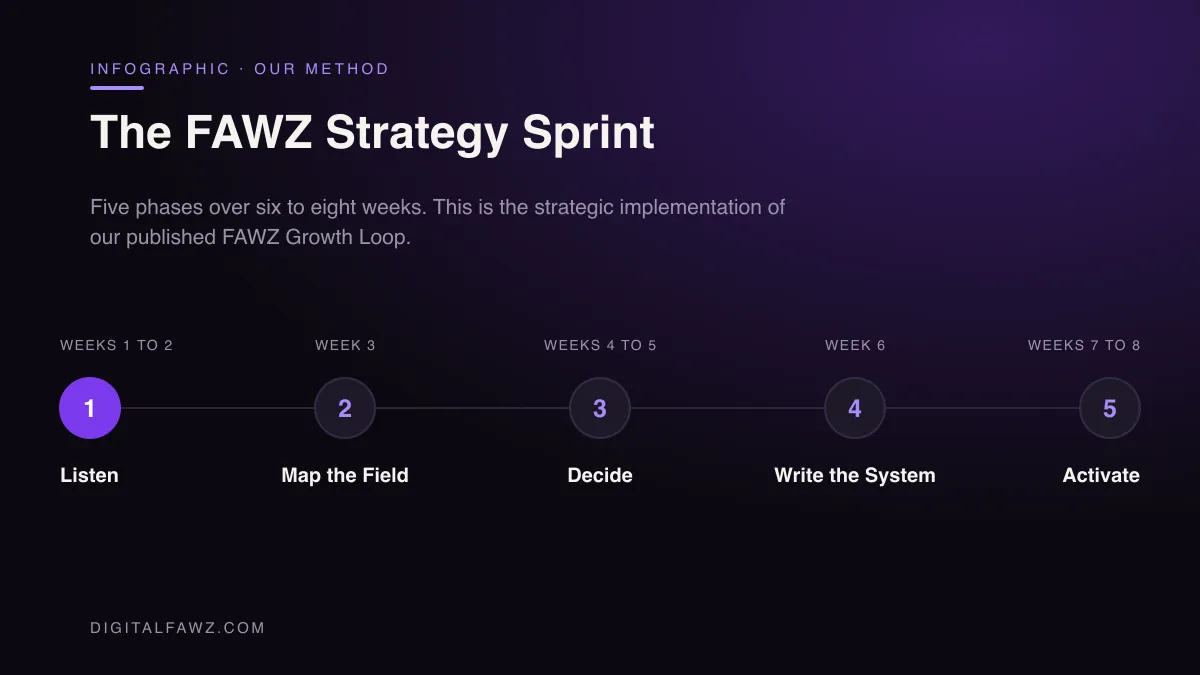
Listen
We interview your customers, your lost deals, your sales team and your founders, separately, because they never agree and the gaps between their answers are where the strategy hides. Alongside, we audit your analytics, reviews and support tickets for the language buyers use when nobody is marketing at them.
Map the Field
Every competitor and every alternative, including the spreadsheet and the status quo, gets mapped by claim and position. The output is a landscape chart showing exactly where the market is crowded and where a credible open position exists for you. Most clients see their industry clearly for the first time in this meeting.
Decide
A structured workshop where positioning options are debated against the research and one is chosen. We force the uncomfortable trade offs here, who you will not serve, what you will not claim, because a strategy without sacrifice is a wish list. Decisions get written down with their reasoning, which ends the relitigating that kills most strategies.
Write the System
The positioning, messaging hierarchy, voice framework and competitive stance get authored into a strategy document designed for daily use: short enough to read, specific enough to settle arguments, with examples drawn from your real materials rewritten under the new position.
Activate
We brief your teams and partners, deliver message maps and rewritten cornerstone copy, and define the measurement plan: message recall, win rate on strategic deals, and the six month new hire test. Strategy is judged by behavior change, and this phase is where behavior starts changing.
Transparent Pricing
Plans.
Project pricing for a defined deliverable, quoted before work begins. The thirty day guarantee covers the research phase of every engagement.
Positioning Sprint
$3,500
one time · for startups pre launch or pre raise
- Founder and customer interviews
- Competitive landscape map
- Positioning statement and rationale
- Core messaging hierarchy
- Homepage copy direction
Full Strategy · Most Popular
$7,500
one time · for growth stage companies
- Everything in the Sprint
- Win loss and lost deal analysis
- Voice and tone framework
- Sales message maps
- Rewritten cornerstone page copy
- Team activation workshop
Portfolio Strategy
$12,000+
one time · for multi product and multi brand companies
- Everything in Full Strategy
- Brand architecture design
- Naming system for the portfolio
- Internal rollout program
- Quarterly strategy reviews, year one
- Executive alignment sessions
Side by Side
Us versus a typical agency.
Seven questions that separate strategy from a deck of adjectives. Ask them before you buy thinking from anyone.
| Question | Typical Agency | Digital Fawz |
|---|---|---|
| What is the research base? | A stakeholder questionnaire | Customer, lost deal and sales interviews |
| What does positioning exclude? | Nothing, it flatters everyone | Explicit trade offs and who you are not for |
| Could a competitor say your claim? | Usually, word for word | Tested until the answer is no |
| What form does it ship in? | A 90 slide deck | A usable document plus activation kit |
| Does sales get anything? | Rarely considered | Message maps and objection language |
| How is success measured? | It is not | Win rate, recall and the new hire test |
| Who leads the work? | A junior with a template | A senior strategist, start to finish |
Brand Strategy Near You
Service areas.
Local market pages with city specific data, unique photography and localized case studies, never templated doorway pages.
Check It Yourself
Where this comes from.
Standards bodies, platform documentation and regulators, so nothing on this page rests on our word alone.
Ten usability heuristics
Positioning has to survive contact with an interface, and these are the rules it meets.
Creating helpful content
What a clearly positioned brand publishes tends to be what this describes.
Straight Answers
Strategy questions.
The questions buyers ask us on every discovery call, answered before the call.
What is included in a brand strategy engagement?
Customer and stakeholder research, competitive landscape mapping, a positioning statement with documented rationale, audience definition, messaging architecture, voice and tone framework, and an activation kit with sales message maps and rewritten cornerstone copy. Larger engagements add brand architecture, naming systems and executive alignment programs.
How much does brand strategy cost?
Our positioning sprints start at 3,500 US dollars, full strategy engagements at 7,500 dollars, and portfolio strategy programs at 12,000 dollars and above. Consulting firms charge five to twenty times that for comparable work with longer timelines. The honest comparison, though, is against the cost of not deciding: a year of scattered campaigns burns more than any strategy engagement ever will.
How is brand strategy different from a marketing strategy?
Brand strategy decides what you stand for and how you are positioned against alternatives. Marketing strategy decides which channels, budgets and campaigns will carry that position to market. Brand strategy comes first, because a marketing plan executing a fuzzy position just distributes the fuzz more efficiently. We offer both, and they are designed to snap together.
We are a small business. Is brand strategy overkill?
The smaller you are, the less you can afford to waste messaging. A large brand can bludgeon the market with budget; a small one has to win on sharpness. The Positioning Sprint exists exactly for this case: two to three weeks, the core decisions, and homepage direction you can execute immediately. Most small clients tell us it changed their sales conversations before it changed their marketing.
What if we disagree with the strategy you recommend?
Then we argue it out with evidence on the table, which is the healthiest thing that can happen in the process. Every recommendation traces back to research you can inspect: interview quotes, win loss patterns, landscape data. Sometimes clients overrule a recommendation for reasons the research could not see, and that is fine, the document records the decision and the reasoning either way. What we will not do is present three options and let you pick by mood.
How long until we see results from repositioning?
Internal results are immediate: teams stop debating what to say and start saying it. Market results follow the rollout: sales conversations shift within the first quarter as message maps deploy, and measurable movement in win rates and recall typically shows within two quarters. Brand tracking metrics like unaided awareness move on longer cycles and we set that expectation honestly upfront.
Do we need brand strategy before a rebrand or a new website?
Yes, and this is the most expensive lesson in the industry. A rebrand or rebuild without positioning produces beautiful ambiguity: new colors saying the same nothing. Strategy first means the designers and writers receive decisions instead of adjectives, and the visual identity gets judged on strategy fit rather than personal taste. Every branding and web project we run includes or begins from this groundwork.
Who from our side needs to be involved?
Decision makers in the workshop, honestly all of them, because a positioning decision made without the CEO gets unmade by the CEO. Beyond that, we need introductions to eight to twelve customers and lost prospects for interviews, and access to your sales team for an hour each. Total leadership time across the engagement is typically six to eight hours, front loaded into discovery and the decision workshop.
Stronger Together
Related services.
Strategy compounds fastest when it runs beside these three.
Branding Services
Strategy decides what to say; identity design makes it visible. Together they produce a brand that looks like what it means.
Content Writing
Messaging architecture becomes real in the words on your pages. Writers executing a strategy beat writers guessing at one.
SEO Services
Positioning defines the topics you deserve to own; SEO builds the authority that makes search engines agree.
Your competitors are guessing. Stop matching them.
Free positioning review: we assess your current messaging against your three loudest competitors and name the open position. Delivered within five business days.
Get Your Free Positioning Review