Ecommerce · Any Platform · Revenue First
Ecommerce built around how your customers actually buy
Store builds, replatforms and revenue engineering on Shopify, WooCommerce and custom stacks. We design catalogs around buying behavior, engineer checkouts that do not leak, and integrate the systems that keep operations sane at scale.
Get Your Free Ecommerce AuditSee Ecommerce Case Studies
The Honest Overview
What ecommerce development actually is.
A definition first, because an online store is an operations system wearing a storefront.
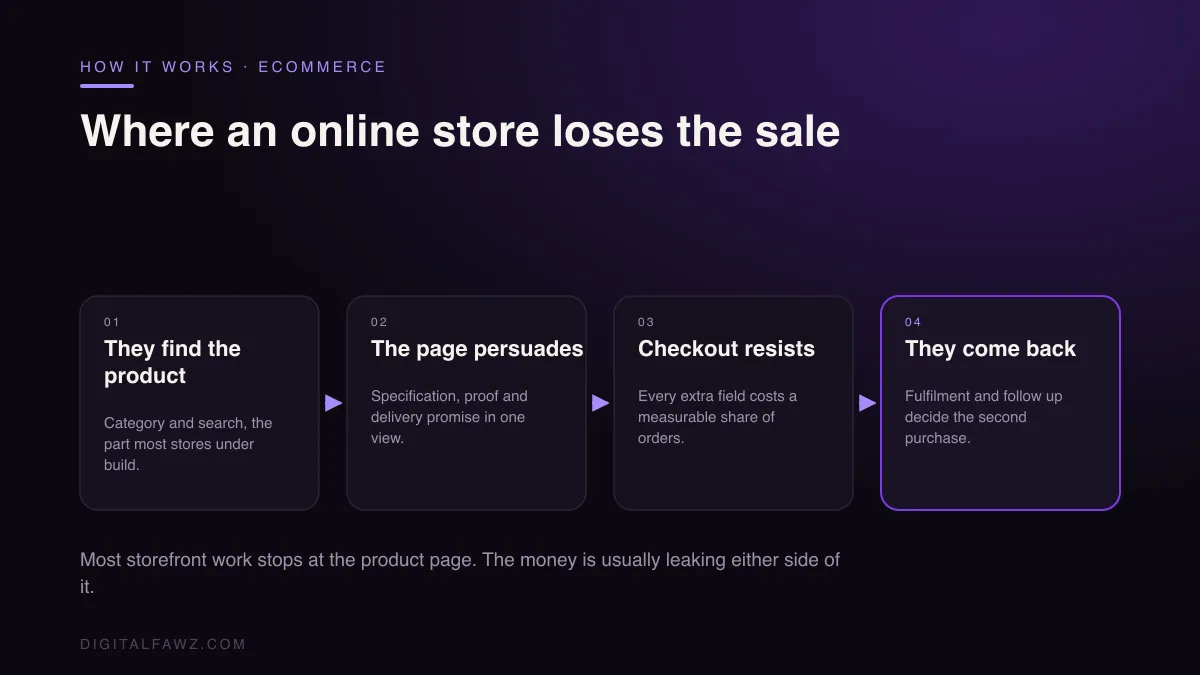
Start with the industry's most expensive statistic: roughly 70 percent of shopping carts are abandoned. Seven in ten people who wanted your product enough to put it in a cart left without paying. The reasons are documented every year and barely change: surprise costs at checkout, forced account creation, too many form fields, unclear delivery times, payment methods missing. Every one of those is an engineering decision, which means every one of them is fixable by engineering.
Now zoom out, because the storefront is only half the machine. Real ecommerce businesses die operationally more often than they die aesthetically: inventory oversold across channels because systems do not sync, orders re-keyed by hand into accounting, shipping rules that undercharge on every heavy parcel, a bestseller silently out of stock on the site for a week. The glamorous work is the product page; the profitable work is the plumbing. We build both, because a store that sells well and operates badly just loses money faster.
Catalog architecture is the third pillar nobody budgets for. How products, variants, categories and filters are structured determines whether customers find things, whether Google ranks your collections, and whether adding your thousandth SKU takes ten minutes or a migration. We design catalogs around buying behavior, how your customers narrow choices, not around your supplier's spreadsheet, and the difference shows up in both conversion and organic traffic.
And because we are platform agnostic, the recommendation you get is the platform your business needs, not the one we happen to resell. Shopify for speed to market and operational simplicity. WooCommerce when content and commerce entwine deeply or ownership matters. Custom stacks when your model, B2B pricing tiers, marketplaces, unusual checkout logic, refuses to fit the boxes. The audit produces that recommendation in writing, with the trade offs, before you commit to anything.
Our ecommerce team has built and rescaled more than 50 stores: fashion catalogs with brutal variant complexity, consumables on subscription, B2B wholesale portals with negotiated pricing, and cross border brands selling in four currencies. That breadth is the point. Patterns transfer: the checkout flow that fixed a fashion brand's mobile abandonment applies, adapted, to a supplement brand's subscription signup. When you hire us you rent that pattern library, not just the hours.
The revenue lens stays on after launch. Average order value engineering through bundles and thresholds, retention through post purchase flows and subscription mechanics, international expansion through localized pricing, taxes and payment methods. Ecommerce is the one discipline where every improvement is measured in currency by default, and we like being judged that way.
Browse the ecommerce portfolio to see the numbers behind these claims.
Deliverables
What every engagement includes.
Eight workstreams covering the storefront your customers see and the operations machine they never do.
Store Development
Full builds on Shopify, WooCommerce or custom stacks, engineered from a written spec around your catalog and customers.
Catalog Architecture
Products, variants, categories and filters structured around buying behavior, scalable to your ten thousandth SKU.
Checkout Engineering
Friction audits and rebuilds of the money pages: fewer fields, honest costs early, local payment methods, express wallets.
Systems Integration
Inventory, ERP, accounting, fulfillment and marketing connected so data flows without re-keying and stock never lies.
Ecommerce SEO Build
Collection and product page architecture with complete schema, so category keywords become a permanent acquisition channel.
Retention Mechanics
Subscriptions, loyalty, reviews and post purchase flows built in, because the second order is where ecommerce margins live.
Analytics & Attribution
Server side tracking, enhanced conversions and dashboards that tie every order to its source, ready for our paid media team.
International Selling
Multi currency, localized payments, duties and tax handling, and market specific storefronts for cross border growth.
Infographic · Our Method
The FAWZ Commerce Sprint.
Five phases from audit to compounding. This is the ecommerce implementation of our published FAWZ Growth Loop.
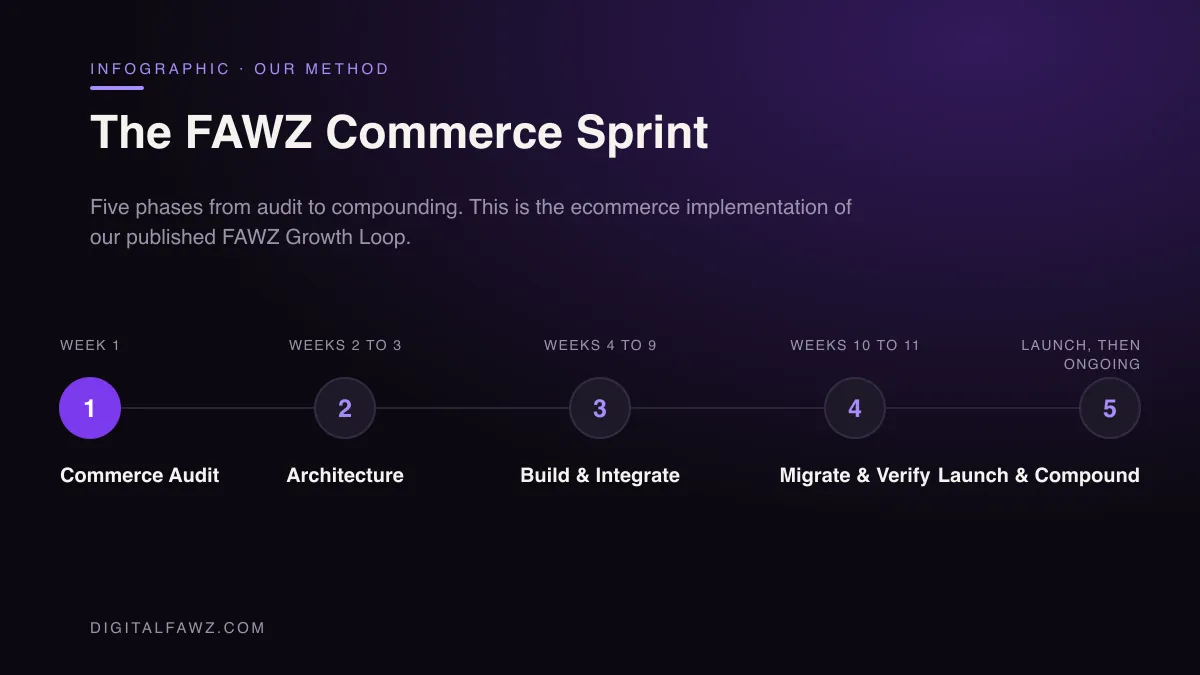
Commerce Audit
We map your funnel by device and market, audit the catalog structure, price the operational leaks, oversells, manual re-keying, shipping mispricing, and benchmark the SEO assets worth protecting. The output is a written spec and platform recommendation with reasoning you can interrogate.
Architecture
Catalog schema, URL strategy, integration map and checkout flow design come before visual design, because these decisions carry revenue and operations for years. Every integration gets specified against real data samples, not vendor brochures, which is where surprises are cheapest to find.
Build & Integrate
Storefront built in weekly staging increments, checkout engineered with express wallets and market appropriate payment methods, systems connected and tested against real workflows: an order placed, picked, shipped, refunded and reconciled end to end before launch day ever sees traffic.
Migrate & Verify
For replatforms: products, customers, orders and reviews migrate with integrity checks, every legacy URL gets its redirect, and rankings are benchmarked for the transition watch. For all builds: real device QA, payment testing across methods, and load testing sized to your promotional spikes.
Launch & Compound
Cutover in your quietest window with monitoring live, thirty days of post launch care, then the optional growth retainer: conversion testing, average order value engineering, retention flows and international expansion, prioritized by projected revenue and reported in it too.
Transparent Pricing
Plans.
Fixed project pricing from a written spec, platform agnostic. The thirty day guarantee applies to every engagement.
Store Build
$5,000
one time · for launching or relaunching a store
- Platform recommendation and build
- Catalog architecture
- Checkout and payments setup
- Product schema and SEO foundation
- Analytics and training
Replatform · Most Popular
$12,000
one time · for outgrown or leaking stores
- Everything in Store Build
- Full data migration with integrity checks
- Ranking protection and redirect map
- ERP and fulfillment integrations
- Checkout re-engineering
- 30 day post launch care
Commerce Platform
$25,000+
one time · for B2B, marketplaces and custom models
- Everything in Replatform
- Custom functionality and APIs
- B2B pricing and account portals
- International markets architecture
- Load tested for peak events
- Dedicated project engineer
Side by Side
Us versus a typical agency.
Seven questions that reveal whether an ecommerce vendor thinks in screenshots or in revenue. Ask them all.
| Question | Typical Agency | Digital Fawz |
|---|---|---|
| Platform recommendation based on? | Whatever they resell | Your catalog, team and model, in writing |
| Checkout approach? | Platform defaults | Engineered: fields, costs, wallets, local methods |
| Operations integration? | 'There's an app' | Specified and tested against real workflows |
| Catalog structure? | Supplier spreadsheet imported | Architected around buying behavior |
| Replatform data handling? | CSV export, fingers crossed | Integrity checked migration with benchmarks |
| What does reporting lead with? | Sessions and pageviews | Revenue per session and order economics |
| Post launch? | New quote for every fix | 30 days care, then optional growth retainer |
Ecommerce Development Near You
Service areas.
Local market pages with city specific data, unique photography and localized case studies, never templated doorway pages.
Check It Yourself
Where this comes from.
Standards bodies, platform documentation and regulators, so nothing on this page rests on our word alone.
Ecommerce SEO guidance
Google's own documentation for storefronts, from architecture to product markup.
Merchant Center requirements
What a product feed must contain before it can be sold against.
Straight Answers
Ecommerce questions.
The questions buyers ask us on every discovery call, answered before the call.
What is included in your ecommerce development services?
Depending on tier: platform selection with written reasoning, store build on Shopify, WooCommerce or a custom stack, catalog architecture, checkout engineering, payments setup, ERP and fulfillment integrations, ecommerce SEO with complete schema, data migration with ranking protection, analytics, training and a thirty day post launch care window.
How much does ecommerce development cost?
Store builds start at 5,000 US dollars, replatforms with full data migration at 12,000 dollars, and custom commerce platforms at 25,000 dollars and above. Industry wide, serious ecommerce builds run from several thousand dollars to well past six figures for enterprise. The more useful math is payback: our average replatform recovers its cost within two quarters through conversion and operational gains.
Which ecommerce platform is best for my business?
The honest answer is that it depends on your catalog complexity, team, content strategy and margins, which is why our audit produces a written recommendation instead of a reflex. As rough guidance: Shopify wins on speed to market and operational simplicity, WooCommerce wins when content and commerce intertwine or ownership matters, and custom stacks win when B2B pricing, marketplaces or unusual checkout logic refuse to fit standard boxes. We build all three, so the recommendation has no thumb on the scale.
Can you replatform our store without losing revenue?
Yes, with engineering rather than optimism. We benchmark rankings and conversion before the move, migrate products, customers, orders and reviews with integrity checks, map every legacy URL to a 301 redirect, cut over in your quietest trading window and monitor daily through the transition. The stores that lose revenue in replatforms are the ones that treated migration as an export button, and ours never do.
Why are so many of my carts abandoned, and what can development do about it?
Around 70 percent abandonment is the industry baseline, and the causes are boringly consistent: surprise shipping costs, forced account creation, long forms, missing payment methods and slow pages. Development fixes each one directly: costs shown early, guest checkout defaulted, address autocomplete, express wallets like Apple Pay and Google Pay, localized payment options and sub two second loads. Recovering even a tenth of abandoned carts is usually the single largest revenue lever a store has.
Can you connect the store to our inventory, accounting and shipping systems?
Yes, and we treat it as core scope, not an add on. Inventory sync that prevents overselling across channels, order flow into accounting without re-keying, fulfillment and carrier integrations with correctly priced shipping rules, and returns workflows that update stock honestly. Integrations are specified against your real data and tested end to end, an order placed, shipped, refunded and reconciled, before launch.
Do you handle international and multi currency selling?
Yes. Market aware pricing, localized payment methods, duty and tax calculation at checkout, translated storefronts where the business case supports them, and delivery promises based on real carrier data per destination. Cross border is often the cheapest growth available to a proven store, because it monetizes demand you already receive, and our case studies show exactly that pattern.
What happens after launch, do we need a retainer?
Every project includes thirty days of post launch care: monitoring, fixes and support while the new store beds in. After that the growth retainer is genuinely optional, covering conversion testing, average order value work, retention flows and new market expansion. The store is documented and portable either way, which is precisely why most clients choose to continue.
Stronger Together
Related services.
Ecommerce compounds fastest when it runs beside these three.
Shopify Development
Deep platform specialization for the world's most popular commerce stack: themes, headless and Checkout Extensibility.
SEO Services
Collection architecture becomes an acquisition channel when content and authority build on top of clean engineering.
Google & Meta Ads
Clean catalogs feed clean product ads. Our media team scales stores on Performance Max and Meta catalogs daily.
Seventy percent of your carts never check out.
Free store review: your biggest checkout, catalog and operations leaks ranked by revenue impact. Delivered within five business days.
Get Your Free Store Review