GTM Engineering · Signals · Automation
Stop hiring more reps to send more guesses. Build the system instead
GTM engineering replaces manual prospecting with a machine: buying signals in, enriched and verified data through, personalized outbound out, everything landing in your CRM with attribution attached. We build it, run it and hand you the keys.
Get Your Free GTM Engineering AuditSee GTM Engineering Case Studies
The Honest Overview
What GTM engineering actually is.
A definition first, because this role is new enough that half the job adverts describe something else.
The traditional answer to needing more pipeline is hiring more sales development reps. Each one researches accounts by hand, writes sequences by hand, and produces a fairly predictable amount of activity. Doubling output means doubling the payroll, and quality drifts downward as the list gets thinner.
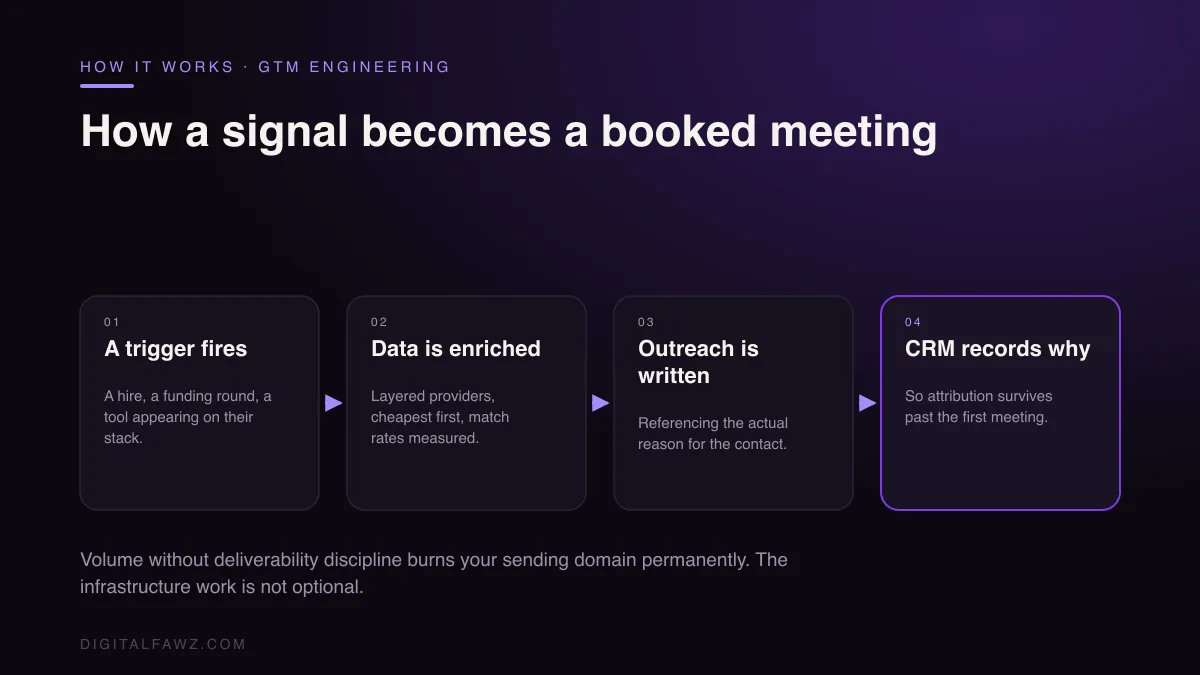
GTM engineering answers the same question with systems. A signal fires, a company hits a trigger you care about, a role changes, a technology appears on their stack, a funding round closes. The system enriches that account through a waterfall of data sources until it has what it needs, verifies the contact, drafts outreach that references the actual reason for the message, and routes it into your CRM with the trigger recorded. Nobody copied anything into a spreadsheet.
The role barely existed three years ago. Clay named it in 2023, and job postings have grown roughly threefold year on year, with median advertised base pay for an in house GTM engineer in the United States sitting around one hundred and thirty five thousand dollars. That number is the entire reason this exists as an agency service: most companies need the system built well once, not a six figure permanent hire to maintain it.
One caution worth stating plainly, because this field attracts a lot of noise. Automated outbound at volume without deliverability discipline is how companies burn their sending domain and end up in spam permanently. The infrastructure work is unglamorous and non negotiable, and any vendor who leads with volume numbers before mentioning domain warm up and inbox placement is going to cost you your email reputation.
We build these systems the way we build software, because that is what they are. Version controlled logic, documented data flows, monitoring on the pipelines that matter and a runbook your team can actually operate. The alternative, which is depressingly common, is a tangle of automations that only the person who built them understands, quietly breaking six weeks after the consultant leaves.
Ownership is the part clients care about most on the second call. The tooling accounts stay in your name, the data stays yours, the Clay tables and workflows are documented and handed over, and we will train your team to run the system rather than keeping it hostage. Our preference is to build it, prove it, then step back to a maintenance role, which is a smaller retainer and an honest one. What happens after the click is a separate discipline, and the page they land on decides whether the meeting is ever booked.
Browse the portfolio to see the numbers behind these claims.
Deliverables
What every engagement includes.
Eight workstreams from the first signal to a routed, attributed opportunity in your CRM.
Signal Sourcing
Deciding which triggers actually predict a buyer in your category, hiring, funding, tech stack changes, job posts, and building the watchers that catch them.
Enrichment Waterfalls
Layered data providers queried in cost order so you pay for the expensive source only when the cheap ones fail, with match rates measured rather than assumed.
Clay Build & Documentation
Tables, formulas, integrations and claygent workflows built to be read by someone else later, with the logic documented instead of living in one person's head.
Deliverability Infrastructure
Sending domains, DNS authentication, warm up schedules and inbox placement monitoring, because volume without this destroys your email reputation permanently.
Personalization That Holds Up
AI assisted copy grounded in the specific trigger and verified facts, with guardrails, because a confidently wrong personalized line is worse than a generic one.
CRM & Routing
Clean writes into HubSpot, Salesforce or your stack, deduplicated, with the originating signal recorded so attribution survives past the first meeting.
Pipeline Reporting
Reply rates, meeting rates and pipeline by signal type, so you learn which triggers are worth money rather than which ones were easiest to automate.
Handover & Enablement
Runbooks, recorded walkthroughs and training so your team operates the system. Accounts and data stay in your name throughout.
Infographic · Our Method
The FAWZ GTM Build.
Five steps, then a maintenance rhythm. This is the revenue systems implementation of our published FAWZ Growth Loop.
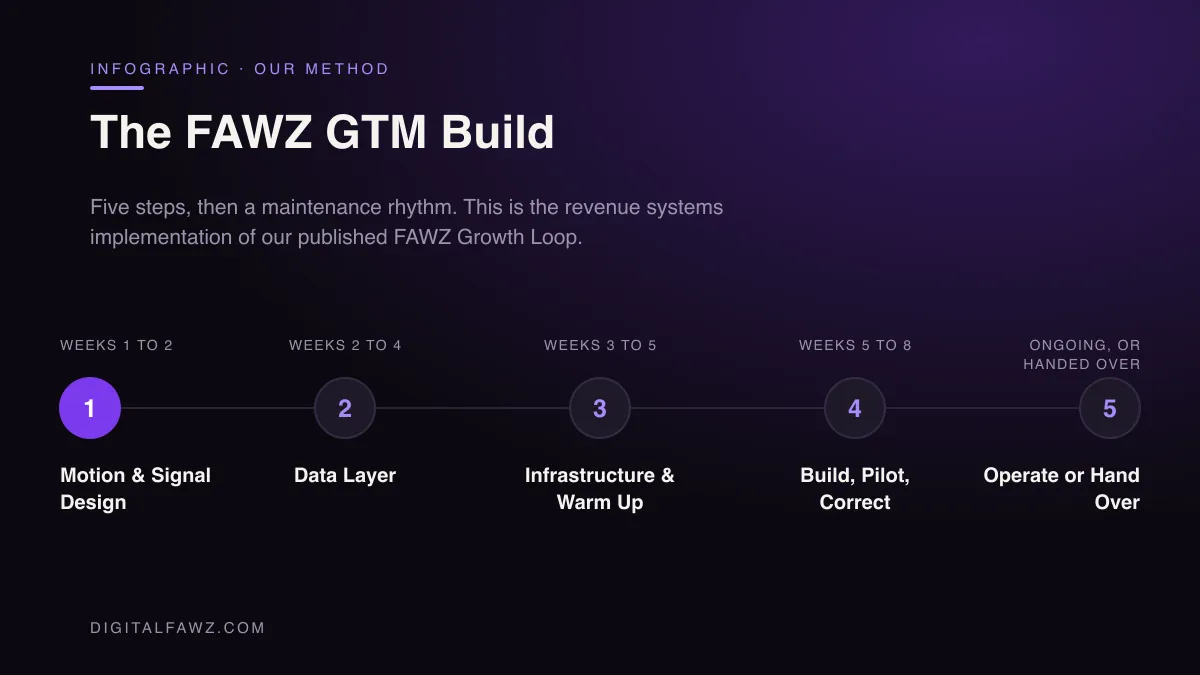
Motion & Signal Design
Before any tooling, we work out who actually buys, what observable event precedes that purchase, and what your team can realistically follow up. Most failed outbound systems are technically fine and aimed at the wrong trigger. The output is a written motion: segments, signals, the message each one earns and the volume your team can absorb.
Data Layer
Enrichment waterfalls get built and, more importantly, measured. We record match rates and cost per enriched record across providers rather than trusting anyone's marketing page, and we deliberately fail records that cannot be verified. A pipeline that guesses produces outbound that embarrasses you.
Infrastructure & Warm Up
Sending domains, authentication, mailbox provisioning and warm up run on their own schedule and cannot be rushed, which is why they start early and in parallel. Inbox placement is monitored from day one. This is the step vendors skip to show you activity faster, and it is the step that decides whether the programme survives.
Build, Pilot, Correct
The system runs live on a deliberately small segment. We read actual replies, not just open rates, and correct the targeting and the copy against what real prospects say back. Volume only increases once reply quality holds, because scaling a bad message just distributes it more widely.
Operate or Hand Over
You choose. We can run the system on a maintenance retainer, or document it, train your team and step back. Either way the accounts, data and workflows are yours, and the handover option is offered rather than hidden, because a system nobody but us can operate is a liability we would rather not sell you.
Transparent Pricing
Plans.
Priced as a build with an optional operating retainer, because most companies need this built properly once rather than staffed permanently. Tooling and data costs are billed to your own accounts, never marked up.
Systems Audit
$2,500
one off · for teams with something already running
- Motion and signal review
- Enrichment and match rate analysis
- Deliverability and domain health check
- CRM and attribution audit
- Prioritized fix roadmap
Build · Most Popular
$9,000+
one off build · typically 6 to 8 weeks
- Full motion and signal design
- Enrichment waterfalls built and measured
- Deliverability infrastructure and warm up
- Clay build with documentation
- CRM routing and attribution
- Runbooks and team training
Operate
$3,200
per month · after a build, entirely optional
- System monitoring and maintenance
- New signals and segments added
- Copy and offer iteration
- Deliverability watch and remediation
- Monthly pipeline reporting
- Or hand over and pay nothing
Side by Side
Us versus a typical agency.
Seven questions that separate systems engineering from a rented spreadsheet. Use them on every vendor call.
| Question | Typical Agency | Digital Fawz |
|---|---|---|
| Who owns the tooling accounts? | The agency's accounts | Yours, in your name, from day one |
| Deliverability handled? | Mentioned after the problem | Domains and warm up start in week three |
| What happens to the data? | Stays on their side | Yours, exportable, no lock in |
| Is the build documented? | Lives in one head | Runbooks, recorded walkthroughs, training |
| Enrichment match rates? | Quoted from the vendor's site | Measured on your list, reported honestly |
| Can you leave? | Retainer continues indefinitely | Handover is offered, not hidden |
| What is reported? | Emails sent | Pipeline and meetings, by signal type |
GTM Engineering Near You
Service areas.
Local market pages with city specific data, unique photography and localized case studies, never templated doorway pages.
Check It Yourself
Where this comes from.
Standards bodies, platform documentation and regulators, so nothing on this page rests on our word alone.
FTC endorsement guides
Disclosure obligations that apply to automated outreach and referral claims.
GA4 measurement reference
Attribution for the sessions your outbound sends, alongside the CRM record.
Straight Answers
GTM Engineering questions.
The questions buyers ask us on every discovery call, answered before the call.
What does a GTM engineer actually do?
A GTM engineer builds and owns the systems that turn buying signals into outbound pipeline: signal watchers, enrichment waterfalls across multiple data providers, tools like Clay for orchestration, cold email infrastructure and deliverability, AI assisted personalization with guardrails, and clean routing into the CRM with attribution attached. It is closer to data engineering than to sales, applied to a revenue problem.
Why hire an agency instead of hiring a GTM engineer?
Median advertised base pay for an in house GTM engineer in the United States is around one hundred and thirty five thousand dollars, and senior roles run considerably higher. Most companies need this system designed and built well once, then maintained lightly. Paying for a permanent senior hire to maintain something that is largely finished is an expensive way to solve a temporary problem, which is exactly why the agency model exists for this role.
How much does a GTM engineering build cost?
Our systems audit is 2,500 US dollars as a one off for teams with something already running. A full build typically starts at 9,000 dollars and runs six to eight weeks. An optional operating retainer is 3,200 dollars per month, and it is genuinely optional, because handover is offered rather than hidden. Tooling and data costs are billed to your own accounts and never marked up.
Will automated outbound damage my email domain?
It absolutely can, and this is the risk most vendors underplay. Sending volume without proper domain separation, authentication, warm up schedules and inbox placement monitoring is how companies land permanently in spam. That is why infrastructure work starts in week three of our builds and runs on its own schedule that cannot be compressed. If a vendor is showing you volume projections before mentioning deliverability, walk away.
Do I own the system when you are finished?
Yes. Tooling accounts are created in your name, the data is yours and exportable, and the workflows are documented with runbooks and recorded walkthroughs so your team can operate them. We would rather sell you a system you could run without us than a dependency you have to keep paying for, which is why the operate retainer is offered as a choice rather than assumed.
How is this different from buying a lead list?
A list is a static file that decays from the moment it is exported. A GTM system is continuous: it watches for events that suggest somebody is in market now, enriches and verifies only those accounts, and reaches out with a message that references the actual reason for the contact. The difference shows up in reply quality, which is the only outbound metric that reliably correlates with pipeline.
What tools do you build on?
Clay for orchestration and enrichment waterfalls in most builds, layered data providers chosen and measured on your actual list rather than on their marketing claims, dedicated sending infrastructure, and whichever CRM you already run, typically HubSpot or Salesforce. We work inside your existing stack wherever it is workable, because migrations create risk that rarely pays for itself.
How long before it produces pipeline?
A build runs six to eight weeks, and deliverability warm up sets the floor on that timeline because it cannot be safely rushed. First replies usually arrive during the pilot in weeks five to eight, on deliberately small volume. Judging the programme fairly takes a full quarter, since reply quality on the first segment tells you whether the signal was right, and correcting the signal is normal rather than a failure.
Stronger Together
Related services.
GTM Engineering compounds fastest when it runs beside these three.
AI Chatbot Development
Inbound and outbound meet at the same funnel. A grounded assistant qualifies the replies your outbound system generates.
Generative AI Systems
The personalization layer is retrieval grounded generation with guardrails, which is the same engineering discipline applied to copy.
Conversion Optimization
Outbound earns the click. What happens on the page after it decides whether the meeting ever gets booked.
Another rep costs six figures. The system costs less.
Free GTM systems audit covering your signals, enrichment match rates, deliverability health and CRM attribution, with an honest read on whether automation is the right answer for you yet.
Get Your Free GTM Audit