Generative AI · Workflows · RAG Systems
Generative AI that does real work, not demos
RAG knowledge assistants, document automation and AI workflows engineered into your actual operations, with grounding, guardrails and human oversight. We build the systems that save hundreds of hours a month, and we measure the hours.
Get Your Free Gen AI AuditSee Gen AI Case Studies
The Honest Overview
What generative AI services actually are.
A definition first, because 'we use AI' now means everything and therefore nothing.
Two years into the generative AI era, most companies are in the same embarrassing place: everyone has ChatGPT open in a tab, nobody has AI in a process. Individual employees paste things into chatbots and get individually faster, while the organization's actual workflows, the quoting, the reporting, the document review, the customer onboarding, run exactly as slowly as they did in 2022. Tool adoption happened. System adoption did not. The gap between those two is where all the return on investment lives.
Here is the test we apply to every AI opportunity: does the task involve reading, writing or transforming information, follow a describable pattern, and happen often enough to matter? Answering RFPs from your past proposals. Turning fifty page reports into board summaries. Extracting terms from contracts into your system. Drafting personalized outreach from CRM data. Producing product descriptions from specs at catalog scale. Each is a system, not a prompt, and each pays back in hours you can count.
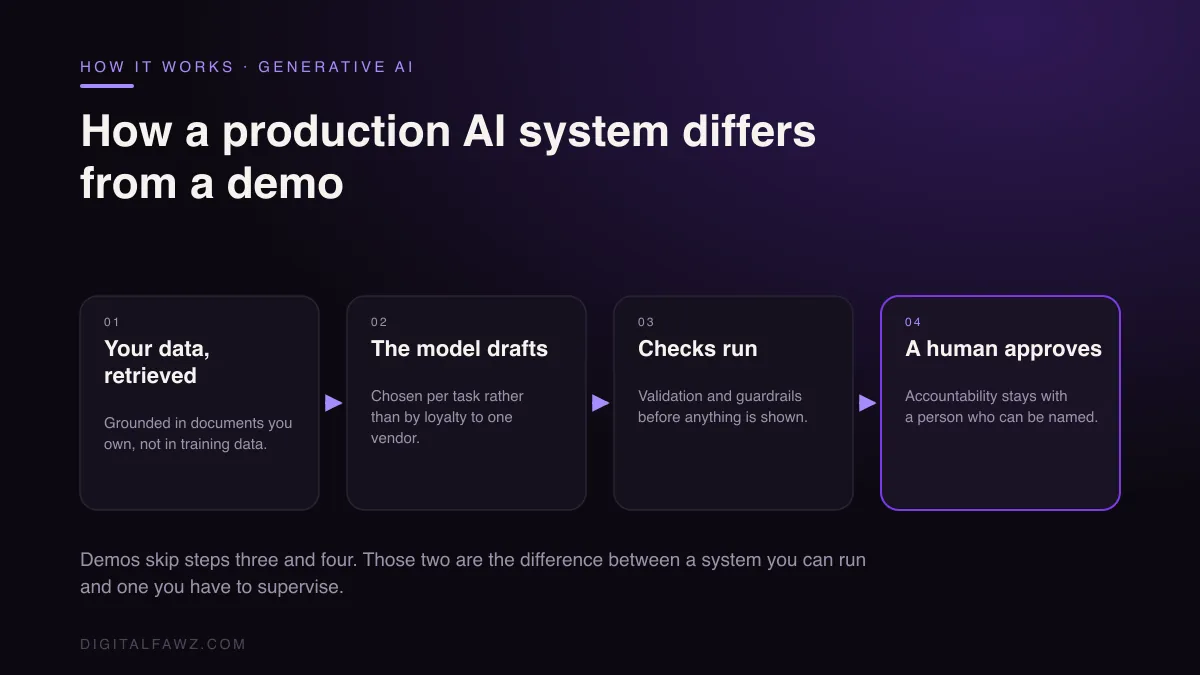
The engineering that separates systems from demos is unglamorous and decisive. Retrieval, RAG, so outputs are grounded in your documents rather than the model's imagination. Structure, so the AI produces your format, your fields, your tone, not freeform text someone still has to fix. Integration, so work flows in from your tools and results flow back automatically instead of through copy paste. And review, human in the loop checkpoints exactly where errors would be expensive, so quality is designed instead of hoped for.
We are also honest about failure modes, because AI projects fail in predictable ways: automating a process nobody actually follows, skipping the data cleanup that grounding requires, or deploying without review steps and losing the team's trust on the first visible mistake. Our process is built to catch each of those before they cost you, starting with an opportunity audit that ranks your candidate workflows by savings, risk and readiness, and tells you plainly which ones are not ready.
Our AI team has shipped more than 25 production systems: knowledge assistants answering from thousands of internal documents, quoting engines that draft proposals from CRM and pricing data, document pipelines extracting structured data from invoices and contracts, and content systems producing catalog scale copy under editorial control. We build on frontier models from Anthropic, OpenAI and Google, chosen per task rather than by loyalty, with your data kept out of anyone's training sets. The same retrieval grounded approach powers the personalization layer inside automated outbound systems, where a confidently wrong sentence costs you the reply.
Every engagement ships with the operational spine that pilots skip: cost monitoring so token spend stays visible, evaluation sets so quality is measured against real examples rather than vibes, fallback behavior for when models change, and documentation plus training so your team runs the system after we leave. AI that works in a demo is easy; AI that still works in month eleven is engineering.
Browse the AI portfolio to see the numbers behind these claims.
Deliverables
What every engagement includes.
Eight deliverables that take an AI system from idea to production and keep it accountable once it is there.
Opportunity Audit
Your workflows ranked by automation value, risk and readiness, with honest 'not yet' verdicts and a projected hours saved figure per candidate.
RAG Knowledge Systems
Assistants grounded in your documents, wikis and data, answering with sources for staff or customers, without hallucinated policy.
Document Automation
Extraction, classification and drafting pipelines for contracts, invoices, reports and RFPs, with review steps where errors cost money.
Content Pipelines
Catalog descriptions, localization and structured content produced at scale under editorial control, in your voice, with QA gates.
Workflow Integration
AI wired into your CRM, helpdesk, drive and databases so work arrives and results return without a human courier.
Guardrails & Review
Grounding, confidence thresholds, output validation and human in the loop checkpoints, placed where mistakes would actually hurt.
Evaluation & Monitoring
Quality measured against curated test sets, cost dashboards for token spend, drift alerts when behavior changes.
Enablement & Handover
Documentation, prompt libraries and team training, so the system is a capability you own, not a dependency you rent.
Infographic · Our Method
The FAWZ AI Sprint.
Five phases from audit to owned capability. This is the generative AI implementation of our published FAWZ Growth Loop.
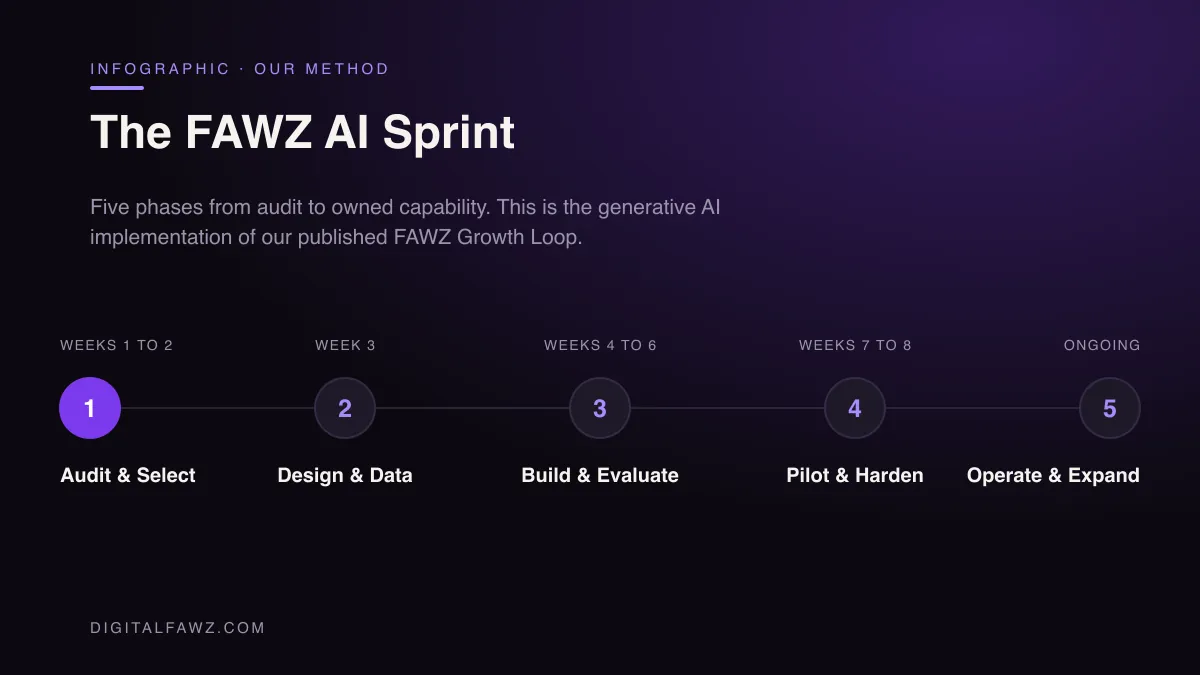
Audit & Select
We map your workflows, interview the people who run them and rank the automation candidates by hours saved, error risk and data readiness. You get the full ranked list, including the tempting ideas we recommend against and why. One workflow gets selected for the first build, chosen to prove value fast.
Design & Data
The selected workflow gets specified end to end: inputs, outputs, format contracts, review checkpoints and success metrics agreed in writing. In parallel, the grounding data gets audited and cleaned, because a knowledge system built on contradictory documents automates confusion.
Build & Evaluate
The system gets built with retrieval, structured outputs and integrations, then measured against an evaluation set of real historical examples before any live use. We iterate until accuracy clears the bar you approved, and you see the evaluation numbers, not a cherry picked demo.
Pilot & Harden
The system runs on live work with human review on every output, tightening prompts, edge cases and integrations against reality. Review rates relax only as measured accuracy earns it, category by category. This is where trust gets built with your team, deliberately.
Operate & Expand
Monitoring, cost dashboards and monthly quality reviews keep the system honest as models and your business change. Then the next workflow from the audit queue begins, compounding the capability. Clients typically automate three to five workflows in year one, each faster than the last.
Transparent Pricing
Plans.
Project pricing for the build, a monthly plan for operation and improvement. The thirty day guarantee covers the audit phase of every engagement.
AI Pilot
$4,000
one time · prove value on one workflow
- Opportunity audit, top 5 ranked
- One workflow built end to end
- Evaluation against real examples
- Team training and documentation
- 30 day pilot support
AI System · Most Popular
$9,000
one time + $800/mo · production grade automation
- Everything in AI Pilot
- Full integrations with your stack
- RAG knowledge base engineering
- Human in the loop review design
- Monitoring and cost dashboards
- Monthly improvement sprints
AI Partner
$6,000+
per month · continuous automation program
- Everything in AI System
- Workflow roadmap execution
- Dedicated AI engineer
- New model evaluation and migration
- Governance and policy support
- Quarterly executive reviews
Side by Side
Us versus a typical agency.
Seven questions that separate AI engineering from AI theater. Ask them before any pilot begins.
| Question | Typical Agency | Digital Fawz |
|---|---|---|
| Where does the project start? | With a tool they resell | With an audit of your workflows |
| Are outputs grounded? | Raw model, fingers crossed | Retrieval from your data, with sources |
| How is quality measured? | A demo that went well | Evaluation sets of real examples |
| Human oversight? | Bolted on after mistakes | Review checkpoints designed in |
| Cost visibility? | Surprise API bills | Token spend dashboards from day one |
| What do you own afterward? | A subscription | The system, prompts, docs and data |
| Honest 'don't automate this'? | Never heard | Built into every audit we deliver |
Generative AI Services Near You
Service areas.
Local market pages with city specific data, unique photography and localized case studies, never templated doorway pages.
Check It Yourself
Where this comes from.
Standards bodies, platform documentation and regulators, so nothing on this page rests on our word alone.
Gemini API documentation
Provider documentation for grounding, context and structured output.
Schema.org vocabulary
A shared vocabulary for describing the entities these systems reason over.
Straight Answers
Gen AI questions.
The questions buyers ask us on every discovery call, answered before the call.
What is included in your generative AI services?
An opportunity audit ranking your workflows by automation value, end to end system builds with retrieval grounding and integrations, human in the loop review design, evaluation against real examples, monitoring and cost dashboards, documentation, training and monthly improvement sprints. Everything we build, prompts, pipelines and knowledge bases, belongs to you.
How much do generative AI services cost?
Pilots start at 4,000 US dollars for one workflow built end to end, production systems at 9,000 dollars plus 800 monthly for operation and improvement, and continuous automation partnerships at 6,000 dollars monthly and above. Every proposal includes a projected hours saved figure, so the investment is judged against a number, not a vibe.
Which workflows should we automate first?
The ones that read, write or transform information, follow a describable pattern, happen frequently and tolerate review. In practice the usual winners are proposal and report drafting, knowledge lookup across scattered documents, data extraction from invoices and contracts, catalog content production and first draft customer communication. The audit ranks your specific candidates, and its most valuable output is often the list of things not to automate yet.
How do you stop the AI from making things up?
With architecture, not hope. Outputs are grounded in your documents through retrieval, formats are constrained so the model fills verified structures rather than free writing, confidence thresholds route uncertain cases to humans, and evaluation sets measure accuracy against real historical examples before and after launch. Where an error would be expensive, a human review checkpoint is designed in deliberately.
Is our data safe, and will it train someone else's model?
Your data stays yours. We use enterprise API configurations with training opt outs, so nothing you process teaches any provider's model. Knowledge bases and pipelines run in your accounts where possible, access is role controlled, and regulated clients get audit logging, retention policies and data processing agreements. Exit is clean by design: everything is documented and exportable.
Which AI models do you use?
The best current model for each task, chosen by benchmark against your actual examples rather than brand loyalty: frontier models from Anthropic, OpenAI and Google, and smaller faster models where the task allows, which often cuts costs dramatically. Systems are built model portable, so when better models ship, and they ship constantly, migration is an evaluation run, not a rebuild.
Will this replace our employees?
In our deployments it replaces the worst parts of their jobs. The pattern across clients is consistent: AI absorbs the repetitive reading, drafting and formatting, and the humans move up to judgment, relationships and volume the team previously could not handle, like the proposal team that now bids sixty percent more opportunities. Systems with human review checkpoints make your experts faster; they do not make them optional.
We tried ChatGPT and results were inconsistent. Why would this be different?
Because a chat tab has no grounding, no structure, no integration and no evaluation, so quality depends entirely on who is typing and how they feel that day. Systems fix each variable: retrieval grounds answers in your data, format contracts standardize outputs, integrations remove the copy paste, and evaluation sets measure quality continuously. Consistency is precisely the thing engineering adds to raw model access.
Stronger Together
Related services.
Gen AI compounds fastest when it runs beside these three.
AI Chatbot Development
The customer facing member of the family: grounded assistants that answer, book and sell around the clock.
Machine Learning
When the question is prediction, churn, demand, pricing, rather than generation, classical ML models earn their keep.
Content Writing
Human editorial expertise that steers AI content pipelines, because scale without judgment is just fast mediocrity.
Your competitors are automating quietly.
Free AI opportunity audit: your top five automatable workflows ranked by hours saved, with honest verdicts. Delivered within five business days.
Get Your Free AI Audit