Machine Learning · Prediction · Decisions
Machine learning that predicts what happens next
Churn prediction, demand forecasting, recommendations and pricing models built on your data and deployed into your actual operations, with accuracy you can verify and business impact you can count. Prediction is profitable when it changes a decision.
Get Your Free ML AuditSee ML Case Studies
The Honest Overview
What machine learning actually is.
A definition first, because ML is older, cheaper and more practical than the hype cycle suggests.
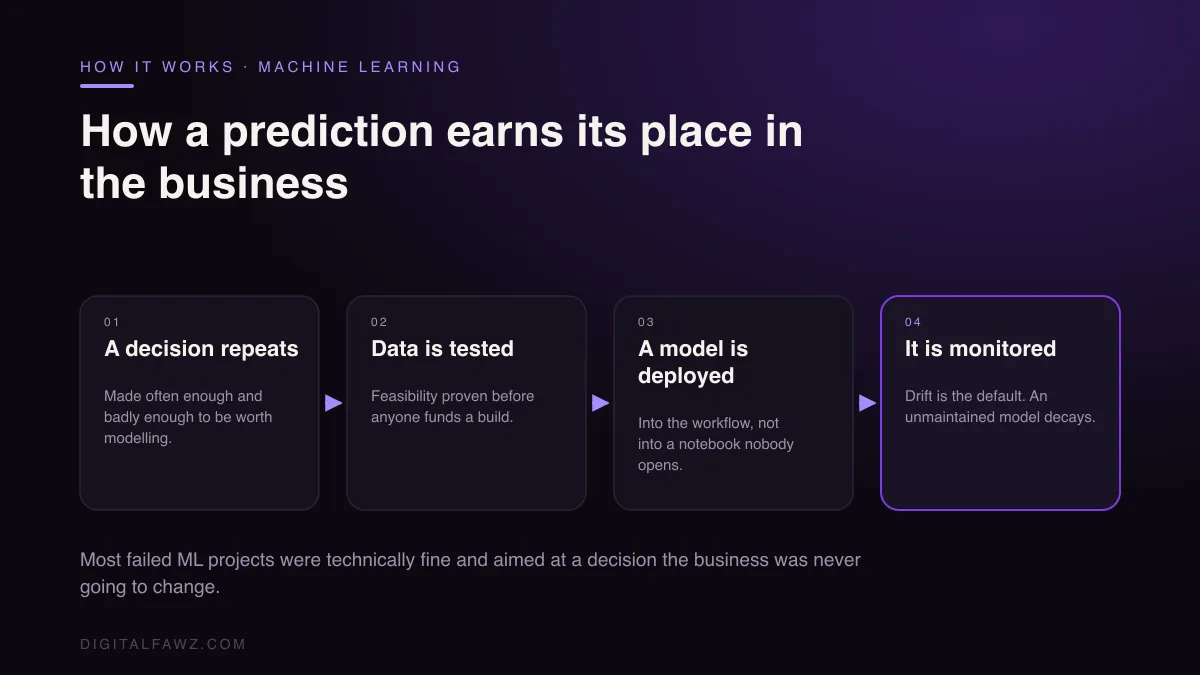
Strip away the buzzwords and machine learning answers one question: given what happened before, what will probably happen next? Which of your customers is drifting toward cancellation, weeks before they announce it. How many units the third week of November will demand, before you place the purchase order. Which price this segment will accept. Which transaction pattern smells like fraud. Your business already generates the data that answers these questions; ML is the machinery that extracts the answer while it is still actionable.
The economics are brutally simple. If churn costs you 40,000 dollars a month and a model plus a retention workflow saves a quarter of it, that is 120,000 dollars a year from one model. If forecasting error forces you to overstock 15 percent as insurance, a better forecast releases that capital permanently. These are not futuristic gains; retailers, banks and airlines have been collecting them for twenty years. What changed is that the tooling got cheap enough for mid sized businesses, and most of them have not noticed yet. That is the arbitrage window.
Now the honesty section, because ML consulting has a credibility problem it earned. Most ML projects fail, and they fail the same three ways: modeling data that is too thin or too dirty to carry a signal, predicting things accurately that nobody acts on, and deploying models that decay silently as reality drifts away from the training data. Notice that none of those are modeling failures. They are scoping, adoption and operations failures, which is why our process spends more energy on those three than on the algorithm.
Our rule is that every model must be attached to a decision before it gets built. Churn scores that trigger a retention playbook. Forecasts that feed the actual purchasing workflow. Recommendations wired into the storefront and the email engine. If we cannot name the decision a prediction will change and the dollar value of changing it, we tell you to keep your money, and we put that in writing in the feasibility audit.
Our ML team has shipped production models for ecommerce brands, SaaS platforms, logistics operations and service businesses: churn and lead scoring, demand forecasting, recommendation engines, dynamic pricing support and anomaly detection. We work in the modern open stack, Python, scikit-learn, XGBoost, PyTorch where deep learning earns its complexity, deployed through APIs and pipelines into the tools your team already uses. The models, code and pipelines belong to you outright.
We are also cheerfully unfashionable about technique. Most business prediction problems are won by gradient boosted trees on well engineered features, not by neural networks with conference paper pedigrees. Simple models that ship, integrate and get maintained beat sophisticated models that live in a notebook. Where deep learning genuinely pays, vision, language, complex sequences, we use it; where it is résumé decoration, we say so.
Browse the AI portfolio to see the numbers behind these claims.
Deliverables
What every engagement includes.
Eight deliverables that carry a model from feasibility to a production system your business trusts and your team owns.
Feasibility Audit
Your data volume, quality and signal assessed against the target prediction, with a build or do not build verdict and projected value.
Data Engineering
Pipelines that clean, join and structure your scattered data into training ready datasets, usually the hardest 60 percent of the work.
Model Development
Churn, forecasting, recommendation, scoring and pricing models built with the simplest technique that clears the accuracy bar.
Validation & Backtesting
Accuracy proven on held out history your model never saw, so performance claims are evidence, not enthusiasm.
Deployment & Integration
Models served through APIs and jobs into your CRM, store, dashboards and workflows, where decisions actually happen.
Decision Playbooks
The workflows that act on predictions, retention triggers, purchasing rules, pricing bands, designed with your team.
Monitoring & Retraining
Drift detection, accuracy tracking and scheduled retraining, because a model is a perishable good that must be maintained.
Governance & Handover
Documentation, bias checks where decisions touch people, and training so your team owns the system confidently.
Infographic · Our Method
The FAWZ ML Sprint.
Five phases from feasibility to maintained production. This is the machine learning implementation of our published FAWZ Growth Loop.
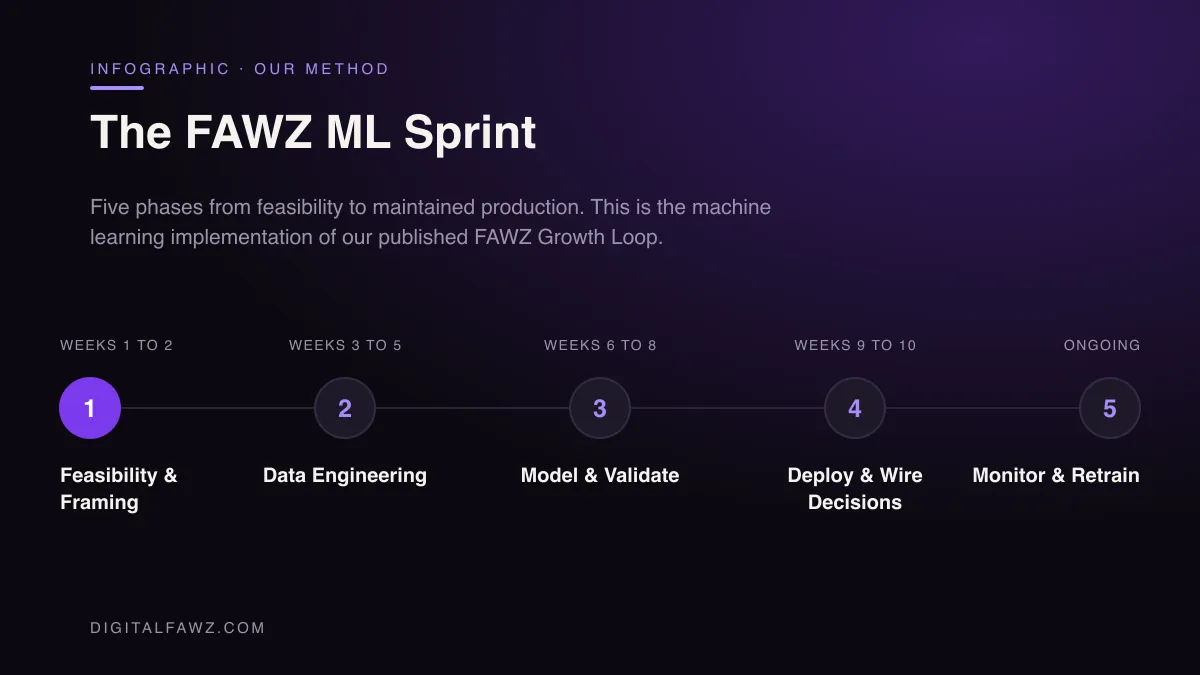
Feasibility & Framing
We audit your data and frame the prediction target around a real decision with a real dollar value. The deliverable is a build or do not build verdict with reasoning: expected accuracy range, integration path and projected return. Roughly a third of audits end in 'not yet, fix the data first', which is the cheapest advice we sell.
Data Engineering
The unglamorous majority of every ML project: joining your CRM, store, billing and analytics data, resolving contradictions, engineering the features that carry signal. Every transformation is pipelined and documented, so retraining next quarter is a command, not an archaeology dig.
Model & Validate
Candidate models get trained and judged on held out history they never saw, against a baseline including 'what you do today'. You see the honest comparison: accuracy, false positive costs and the confusion cases. The model that ships is the simplest one that clears the bar you approved.
Deploy & Wire Decisions
The model goes into production behind an API or scheduled job, integrated where the decision lives: churn scores into the CRM with retention triggers, forecasts into the purchasing sheet, recommendations into the storefront. A prediction nobody sees is a prediction nobody uses, so the wiring is the point.
Monitor & Retrain
Dashboards track live accuracy and data drift, retraining runs on schedule or on alert, and quarterly reviews measure the business impact against the original projection. Models decay as the world changes; maintained models compound instead.
Transparent Pricing
Plans.
Project pricing for the build, a monthly plan for monitoring and retraining. The thirty day guarantee covers the feasibility phase of every engagement.
Feasibility Sprint
$3,000
one time · know before you build
- Data quality and signal audit
- Prediction target framing
- Build or do not build verdict
- Projected accuracy and ROI
- Data readiness roadmap
Production Model · Most Popular
$12,000
one time + $1,000/mo · one model, fully deployed
- Everything in Feasibility
- Data pipelines and feature engineering
- Model build with backtested validation
- API deployment and integrations
- Decision playbook design
- Monitoring and retraining
ML Program
$8,000+
per month · a prediction roadmap, executed
- Everything in Production Model
- Multiple models on one data platform
- Dedicated ML engineer
- Experiment and A/B measurement
- Governance and bias auditing
- Quarterly executive reviews
Side by Side
Us versus a typical agency.
Seven questions that separate ML engineering from ML theater. Ask them before anyone touches your data.
| Question | Typical Agency | Digital Fawz |
|---|---|---|
| What gets modeled? | Whatever data exists | A prediction attached to a priced decision |
| Accuracy claims based on? | Training data performance | Held out backtests you can inspect |
| Technique choice? | The fanciest fundable | The simplest that clears the bar |
| Where does the model live? | A notebook on a laptop | Production APIs inside your workflows |
| What about model decay? | Never mentioned | Drift monitoring and scheduled retraining |
| Who owns the models? | Locked in their platform | You: code, pipelines and weights |
| Ever advised not to build? | Never | A third of our audits say exactly that |
Machine Learning Services Near You
Service areas.
Local market pages with city specific data, unique photography and localized case studies, never templated doorway pages.
Check It Yourself
Where this comes from.
Standards bodies, platform documentation and regulators, so nothing on this page rests on our word alone.
Gemini API documentation
Where hosted model capability ends and a custom model starts earning its cost.
GA4 measurement reference
Most prediction work starts with behavioural data this tool already collects.
GDPR explained
Automated decision making carries obligations worth reading before you build.
Straight Answers
ML questions.
The questions buyers ask us on every discovery call, answered before the call.
What is included in your machine learning services?
A feasibility audit with a build or do not build verdict, data engineering and feature pipelines, model development validated on held out history, production deployment into your systems, decision playbook design, drift monitoring with scheduled retraining, documentation and team training. All code, pipelines and models belong to you.
How much do machine learning services cost?
Feasibility sprints start at 3,000 US dollars, a fully deployed production model at 12,000 dollars plus 1,000 monthly for monitoring and retraining, and multi model programs at 8,000 dollars monthly and above. Every proposal carries a projected return figure from the feasibility work, so the spend is judged against a number from your own data.
How much data do we need for machine learning to work?
Less than the hype suggests, more than a spreadsheet export. As rough guidance: churn and scoring models want a few thousand historical examples with outcomes, forecasting wants two plus years of history to capture seasonality, and recommendations want meaningful interaction volume. The feasibility audit answers this precisely for your case, and if the honest answer is 'collect six more months of data first', that verdict costs you 3,000 dollars instead of a failed project.
What is the difference between machine learning and generative AI?
Generative AI produces content: text, answers, drafts, built on large language models. Classical machine learning produces predictions: numbers, scores, rankings, learned from your historical data. If the question is 'write this' or 'answer from our documents', you want our generative AI services. If it is 'which customers will churn' or 'how much stock do we need', that is ML. Many clients end up with both, sharing one clean data foundation.
Which problems does ML solve best for mid sized businesses?
The proven winners: churn prediction feeding retention campaigns, lead scoring so sales works the right queue, demand forecasting for inventory and staffing, recommendation engines for cross sell, pricing support and anomaly detection for fraud or quality. Common thread: frequent decisions, historical data with outcomes, and a measurable cost of guessing wrong. If your problem fits that pattern, ML probably pays.
How do we know the model is actually accurate?
Backtesting: the model is validated on a slice of your history it never saw during training, simulating exactly how it would have performed live. You see accuracy against a baseline including your current method, plus the cost weighted error analysis, because a false positive and a false negative rarely cost the same. No model ships until it clears the bar you approved on evidence you can inspect.
What happens when the model gets stale?
It will, because customer behavior, catalogs and markets drift, so decay is planned for rather than discovered. Monitoring tracks live accuracy and input drift, alerts fire when either moves, and retraining runs on schedule or on trigger through the documented pipelines. This is exactly what the monthly operations plan covers, and it is the difference between a model and a maintained capability.
Do we need a data science team to work with you?
No. We work with your existing analysts, engineers or, frequently, nobody technical at all, since predictions arrive inside tools your team already uses, CRM fields, dashboards, ordering sheets. Documentation and training are included, and if you later hire data staff, they inherit clean pipelines and honest documentation instead of a consultant shaped mystery.
Stronger Together
Related services.
ML compounds fastest when it runs beside these three.
Generative AI Services
Generation and prediction share one data foundation. Content systems and knowledge assistants from the same team.
AI Chatbot Development
Customer facing AI grounded in your knowledge, often the fastest visible win while ML models train.
SEO Services
Search demand data feeds forecasting, and organic growth compounds alongside prediction driven retention.
Your data already knows. Ask it.
Free ML feasibility audit: what your data can predict, what it cannot yet, and what each prediction is worth. Delivered within five business days.
Get Your Free ML Audit