Product Design · Research · Prototyping
Design that users love and metrics can prove
Research first product design for websites, mobile apps and SaaS dashboards. We find out how your users actually think, design flows that match, prototype in Figma, test with real people and hand your developers a spec they will thank you for.
Get Your Free UI/UX AuditSee UI/UX Case Studies
The Honest Overview
What UI/UX design actually is.
A definition first, because 'make it look modern' is a preference, not a process.
Here is a number that should terrify anyone about to build a product. Studies of software projects consistently find that a large share of features, by some counts nearly half, are rarely or never used. Somebody paid designers to design them, developers to build them and testers to test them, and users simply walked past. That is not an engineering failure. That is a research failure that happened months earlier, when nobody checked whether users wanted the thing before building the thing.
The economics of fixing this are absurdly lopsided. Research popularized by IBM found that a design problem costing one dollar to fix at the design stage costs many times more to fix in development and up to a hundred times more after release. A wireframe change is an afternoon. The same change after launch is a sprint, a migration and an apology email. Every dollar spent on UX research is buying down the most expensive category of risk your product has.
And users have never been less patient. Roughly 88 percent of online consumers say they are less likely to return after a bad experience, and they judge fast: credibility assessments form in a fraction of a second and are overwhelmingly design driven. Your users have been trained by the best designed products on earth, and they bring those expectations to your login screen. 'Good enough' interfaces read as neglect.
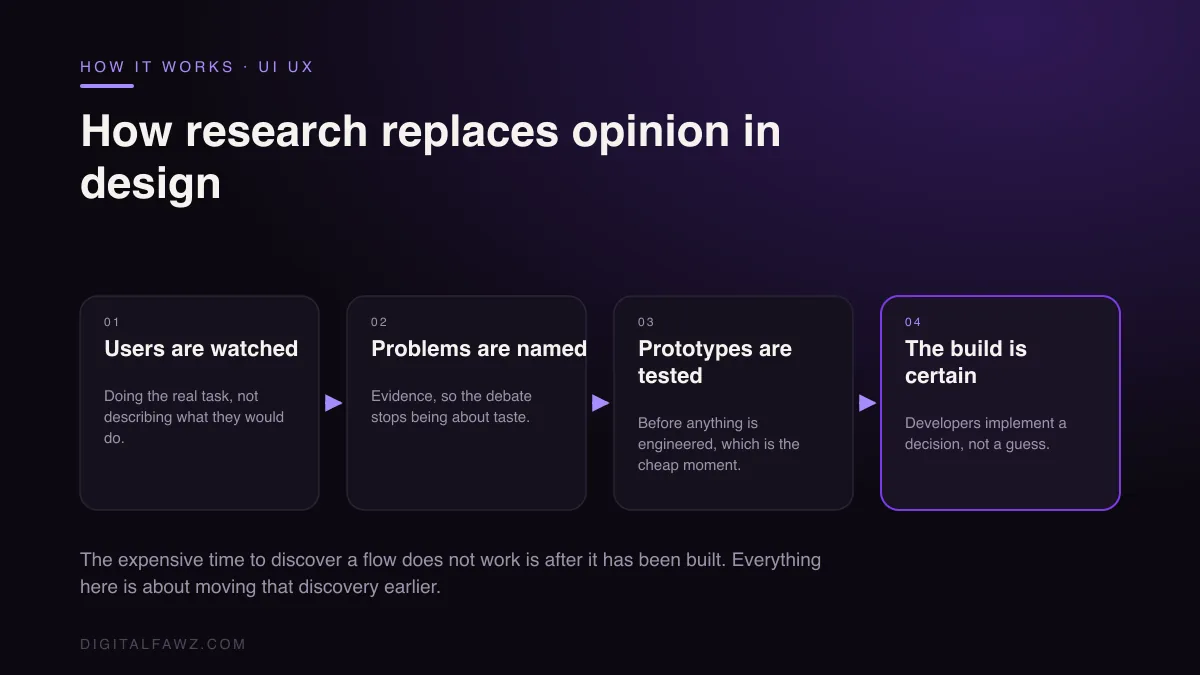
So our process refuses to start in Figma. It starts with your users: interviews, task analysis, analytics review, watching real people struggle through the current flow. Design decisions then have evidence behind them, which does something subtle and valuable: it ends the opinion wars. When the CEO prefers the other layout, the usability test answers, not the loudest voice in the room.
Our design team has shipped more than 70 products: marketing sites, ecommerce experiences, iOS and Android apps, and the hardest category of all, data dense SaaS dashboards where a confused user does not bounce, they churn. Seniority matters here, because most design failures are judgment failures: knowing which convention to follow and which to break, when density beats whitespace, when a wizard beats a form. Our leads carry seven plus years and their portfolios are public, so you can verify the judgment before you rent it.
The deliverable that separates us from most studios is the handoff. Developers receive component specs, interaction definitions, edge states, empty states, error states and accessibility annotations inside an organized Figma file with a working design system, not a folder of pretty screens missing every state that actually occurs in production. Ask any developer what happens to timelines when the design skips edge cases; then ask them what they would pay to never experience it again.
Browse the UI/UX portfolio to see the numbers behind these claims.
Deliverables
What every engagement includes.
Eight deliverables from first interview to final handoff. Research produces the decisions; design makes them tangible; the spec makes them buildable.
User Research
Interviews, task analysis and usability audits that reveal how your users actually think, not how the org chart assumes they do.
Information Architecture
Sitemaps, user flows and navigation structures that put things where users expect them, validated with tree testing when stakes are high.
Wireframes
Low fidelity structure for every screen and state, so layout debates happen when changes cost minutes instead of sprints.
High Fidelity UI
Pixel exact interface design on a grid, with typography, color and component styling aligned to your brand system.
Interactive Prototypes
Clickable Figma prototypes that behave like the real product, ready for stakeholder buy in and user testing before code exists.
Usability Testing
Moderated tests with real users on real tasks, so the flows get proven, and fixed, before development locks them in.
Design System
A component library with variants, tokens and usage rules, so the next ten screens your team designs stay consistent with the first ten.
Developer Handoff
Specs, states, interactions and accessibility annotations documented so completely that developer questions become rare events.
Infographic · Our Method
The FAWZ Design Sprint.
Five phases, scaled to project size. This is the product design implementation of our published FAWZ Growth Loop.
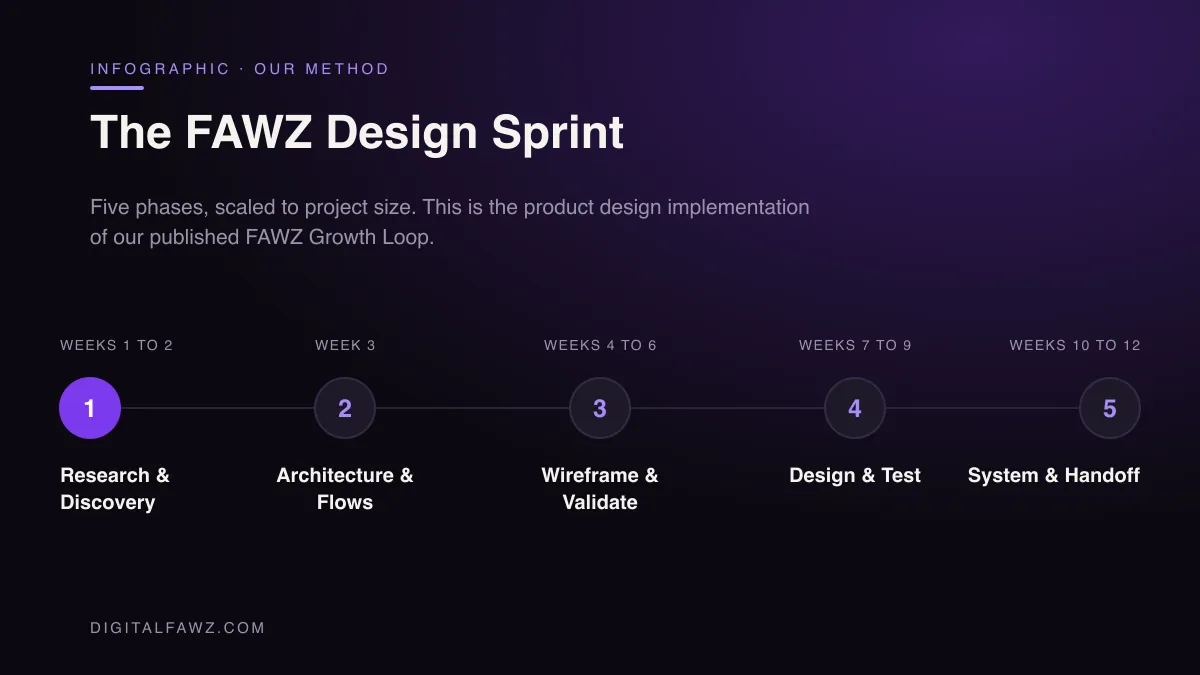
Research & Discovery
User interviews, analytics review, competitive teardowns and a usability audit of whatever exists today. We define the users, their top tasks and the success metrics the design will be judged by. Every project starts here because opinions are free and evidence is cheap compared to rebuilds.
Architecture & Flows
Sitemaps and user flows for every critical journey, from first visit to activated user. The unglamorous decisions that determine usability, what lives in navigation, what a screen is for, what happens after an error, get made and documented here.
Wireframe & Validate
Every screen and state in low fidelity, assembled into a clickable skeleton and walked through with stakeholders and, on larger projects, tested with users. Changing structure costs minutes at this stage. We spend freely here to avoid spending painfully later.
Design & Test
High fidelity UI built on a component system, assembled into an interactive prototype and pressure tested with real users on real tasks. Findings loop back into the design until the top tasks succeed without help. Beauty is a requirement here, but measured task success is the exit criterion.
System & Handoff
The design system gets finalized with tokens, components and usage rules, every state gets specified including the errors and empty screens, and developers get a walkthrough plus direct access to us during implementation. Design that cannot be built faithfully was never finished.
Transparent Pricing
Plans.
Project pricing quoted from scope, not surprises. Research is included in every tier because designing without it is guessing in high fidelity.
Website UX
$4,000
one time · for marketing sites and landing systems
- UX audit and user research
- Information architecture
- Wireframes for key templates
- High fidelity UI design
- Developer ready Figma handoff
Product Design · Most Popular
$9,000
one time · for apps and SaaS products
- Everything in Website UX
- User flows for critical journeys
- Interactive prototype
- Moderated usability testing
- Component design system
- Implementation support
Design Partner
$6,500+
per month · ongoing product design retainer
- Embedded senior designer
- Continuous research and testing
- Design system governance
- Sprint aligned delivery
- Quarterly UX health reviews
- Priority turnaround
Side by Side
Us versus a typical agency.
Seven questions that separate product designers from decoration vendors. Ask them before you hand anyone your roadmap.
| Question | Typical Agency | Digital Fawz |
|---|---|---|
| What comes before screens? | A mood board | User research and task definition |
| Are flows tested with users? | Never, launch and pray | Moderated testing before development |
| Edge and error states designed? | Discovered by developers later | Every state specified in the handoff |
| Design system included? | Disconnected screens | Component library with tokens and rules |
| Accessibility? | An afterthought | WCAG annotations built into specs |
| Developer support after handoff? | A goodbye email | Direct access through implementation |
| How is success measured? | Whether the client likes it | Task success, retention and conversion metrics |
UI/UX Design Near You
Service areas.
Local market pages with city specific data, unique photography and localized case studies, never templated doorway pages.
Check It Yourself
Where this comes from.
Standards bodies, platform documentation and regulators, so nothing on this page rests on our word alone.
Straight Answers
UI/UX questions.
The questions buyers ask us on every discovery call, answered before the call.
What is included in your UI/UX design services?
Depending on tier: user research and usability audits, information architecture, user flows, wireframes, high fidelity UI design, interactive prototypes, moderated usability testing, a component design system and developer ready handoff with every state specified. Implementation support is included so developers reach us directly during the build.
How much does UI/UX design cost?
Website design engagements start at 4,000 US dollars, full product design at 9,000 dollars, and embedded design partnership retainers at 6,500 dollars monthly. Market wide, credible agency product design runs from a few thousand dollars for a landing system to six figures for enterprise platforms. The variable that matters is research and testing depth, which is exactly the part that prevents expensive rebuilds.
What is the difference between UI and UX design?
UX design is the structural work: research, architecture, flows and testing that determine whether users can accomplish their goals. UI design is the visual layer: typography, color, spacing and components that determine how the product looks and feels moment to moment. They are inseparable in practice, a beautiful interface on a confusing structure fails, and so does the reverse, which is why we never sell one without the other.
How long does a design project take?
A website design engagement typically runs four to six weeks. Full product design with prototyping and usability testing runs ten to twelve weeks. Retainer partnerships deliver continuously in sprint cadence with your team. Timelines compress when research materials already exist and stretch when stakeholder alignment is complex; the kickoff estimate we give is one we expect to keep.
Do you design mobile apps as well as websites?
Yes: iOS, Android and responsive web, including products that span all three. Platform conventions differ meaningfully, navigation patterns, gestures, system components, accessibility APIs, and our designs follow each platform's human interface guidelines rather than stretching one layout across every screen size and hoping.
Do you code the designs too?
We can. Our web development team builds what our design team specifies, which removes the classic gap where a design dies in translation. If your own engineers are building, the handoff package plus implementation support serves the same purpose: we stay available through the build, review staging against spec and adjust where reality demands it.
How do you handle usability testing, and do we need it?
We recruit participants matching your user profile, run moderated sessions on your critical tasks, and report findings with severity ratings and design fixes. Whether you need it scales with risk: a marketing site launch can survive skipping it; a SaaS onboarding flow or checkout cannot, because a flaw there taxes every user forever. Five participants typically uncover the large majority of serious issues, so it is far cheaper than its reputation.
Will the design work with our existing brand?
Yes. We design inside your existing brand guidelines when they exist and are workable. When the brand system is too thin for product use, common for companies whose identity was built for print or social, we extend it with the tokens, component styles and interaction states products require, in collaboration with our branding team if deeper work is needed.
Stronger Together
Related services.
UI/UX compounds fastest when it runs beside these three.
Website Development
Design and build under one roof means the site that ships is the site that was designed, at Core Web Vitals speed.
Conversion Rate Optimization
Post launch behavioral data feeds the next design iteration. Design decides, CRO verifies, and the loop compounds.
Branding Services
Product interfaces are your brand's most used touchpoint. Identity and interface designed coherently multiply each other.
Your users are struggling quietly.
Free UX review of your product or website: the top five friction points, with evidence, delivered within five business days.
Get Your Free UX Review